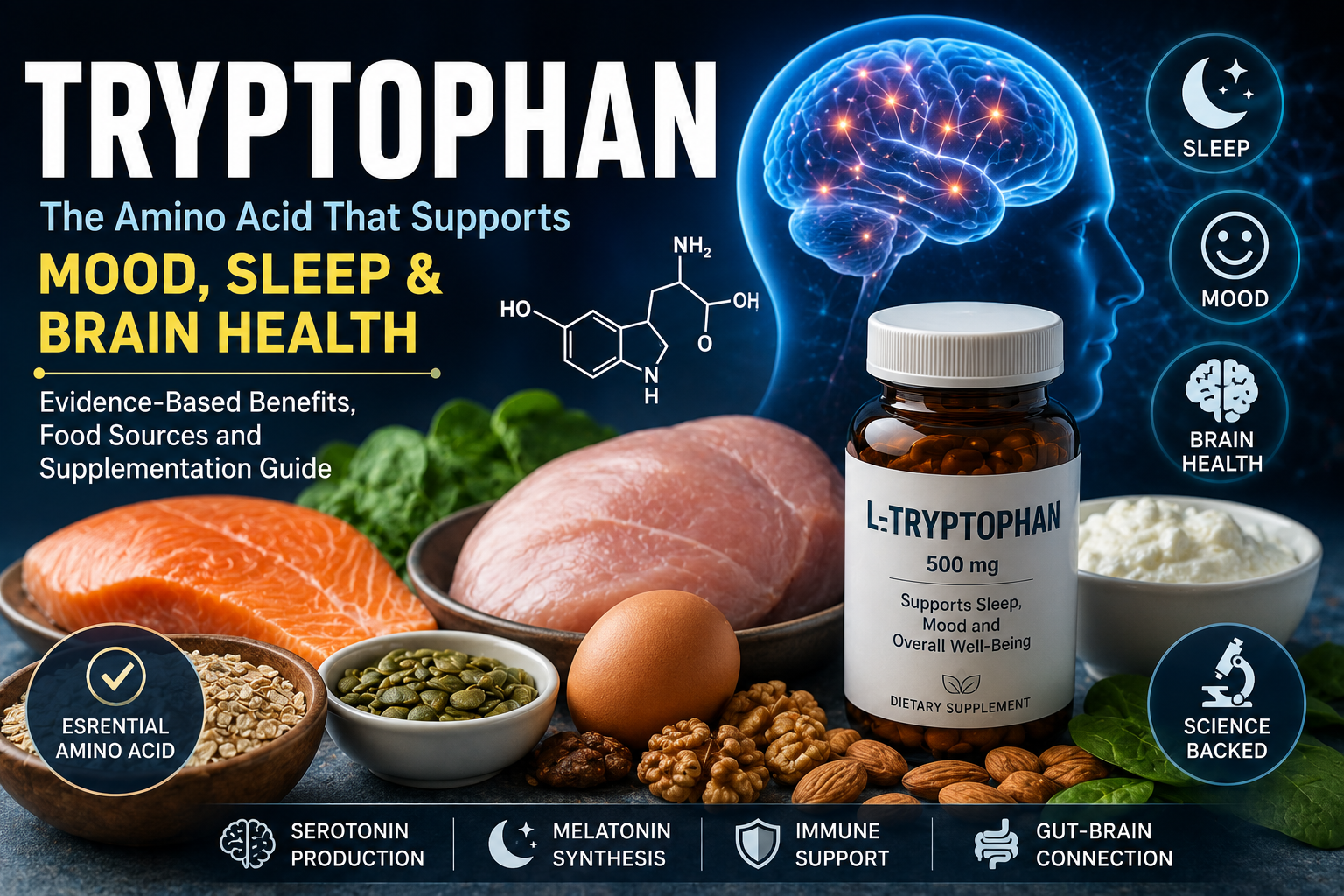

Evidence-Based Guide to Sleep, Mood, Brain Health and Healthy Aging
Part 1 – What Is Tryptophan?
🌟 Introduction
Sleep quality, emotional well-being, cognitive performance, and healthy aging all depend on a complex interaction of nutrients, hormones, neurotransmitters, and lifestyle habits. Among these, tryptophan has attracted considerable scientific attention because it serves as the starting point for the production of serotonin and melatonin, two molecules essential for mental health and circadian rhythm regulation.
Although often marketed as a “natural sleep supplement,” tryptophan plays far broader physiological roles. It is involved in protein synthesis, immune regulation, intestinal health, neurotransmitter production, and numerous metabolic pathways that influence both physical and mental well-being.
Because the human body cannot synthesize tryptophan, it must be obtained through food or dietary supplementation.
This evidence-based guide explores what tryptophan is, how it functions inside the body, and what current scientific research reveals about its importance for overall health.
🧬 What Is Tryptophan?

Tryptophan is one of the nine essential amino acids required for human life.
Unlike non-essential amino acids, essential amino acids cannot be produced by the body and therefore must come from dietary sources.
Its primary functions include:
- 🏗️ Building body proteins
- 🧠 Producing neurotransmitters
- 🌙 Synthesizing melatonin
- 😊 Producing serotonin
- 🛡️ Supporting immune regulation
- ⚡ Participating in energy metabolism
- 🧬 Supporting tissue repair
Because of these diverse roles, adequate tryptophan intake is important throughout life.
🔬 How Is Tryptophan Metabolized?
After digestion, dietary proteins are broken down into amino acids, including tryptophan.
Once absorbed in the small intestine, tryptophan enters the bloodstream and follows several metabolic pathways.
The two most important are:
🧠 Serotonin Pathway
Tryptophan
⬇️
5-Hydroxytryptophan (5-HTP)
⬇️
😊 Serotonin
⬇️
Mood Regulation
Appetite Control
Learning
Memory
Emotional Balance
🌙 Melatonin Pathway
Serotonin
⬇️
🌙 Melatonin
⬇️
Circadian Rhythm
Sleep Preparation
Sleep Quality
Nighttime Recovery
Not all dietary tryptophan becomes serotonin or melatonin.
In fact, most tryptophan (over 90%) is metabolized through the kynurenine pathway, where it contributes to immune regulation, nervous system function, and the production of important cellular molecules.
⚡ Physiological Functions of Tryptophan

😊 Mood Regulation
Serotonin is one of the best-known neurotransmitters derived from tryptophan.
Healthy serotonin production contributes to:
- Emotional stability
- Positive mood
- Stress resilience
- Social behavior
- Overall psychological well-being
However, mood disorders are multifactorial, and serotonin is only one part of a much more complex system.
🌙 Sleep Regulation
Melatonin production begins with tryptophan.
As daylight decreases, the brain converts serotonin into melatonin, helping synchronize the body’s internal clock.
Healthy melatonin production contributes to:
- Faster sleep onset
- Better sleep quality
- Circadian rhythm regulation
- Overnight physiological recovery
🧠 Brain Function
Tryptophan indirectly supports:
- Learning
- Memory
- Cognitive flexibility
- Decision-making
- Attention
Researchers continue investigating its potential role in cognitive aging and neurodegenerative diseases.
🍽️ Appetite Regulation
Serotonin also influences appetite.
It participates in:
- Satiety signaling
- Food preferences
- Emotional eating
- Carbohydrate cravings
This explains why alterations in serotonin metabolism may affect eating behavior in some individuals.
🦠 Tryptophan and the Gut Microbiome
One of the fastest-growing areas of research involves the interaction between tryptophan and gut bacteria.
The intestinal microbiome can influence how tryptophan is metabolized.
Some bacterial species produce metabolites that affect:
- Immune function
- Inflammation
- Brain signaling
- Gut barrier integrity
- Communication between the gut and brain
This relationship is often referred to as the gut-brain axis.
Emerging evidence suggests that maintaining a healthy gut microbiome through diet may indirectly support optimal tryptophan metabolism.
🍽️ Best Food Sources of Tryptophan
Many protein-rich foods naturally contain tryptophan.
Excellent dietary sources include:
🥚 Eggs
🦃 Turkey
🐔 Chicken
🐟 Salmon
🐟 Tuna
🥩 Lean beef
🥛 Milk
🧀 Cheese
🥣 Greek yogurt
🌰 Pumpkin seeds
🥜 Almonds
🥜 Walnuts
🌱 Soybeans
🫘 Lentils
🧆 Chickpeas
🥣 Oats
🍌 Bananas (contain relatively small amounts but are commonly included in balanced meals)
Obtaining tryptophan from a varied diet also provides vitamins, minerals, and other nutrients that support its metabolism.
🧪 Nutrients Required for Tryptophan Metabolism
Tryptophan does not act alone.
Several nutrients serve as cofactors for its conversion into serotonin and melatonin.
These include:
- 💊 Vitamin B6
- 🩸 Iron
- 🧂 Magnesium
- ☀️ Vitamin D (indirect role in neurotransmitter regulation)
- 🧬 Folate
- 💊 Vitamin B12
Deficiencies in these nutrients may impair normal metabolic pathways.
🚨 Can You Become Deficient?
True tryptophan deficiency is uncommon in individuals consuming adequate dietary protein.
However, lower availability may occur in situations such as:
- Severe malnutrition
- Very restrictive diets
- Certain gastrointestinal disorders
- Chronic inflammatory conditions
- Increased metabolic demands
Evaluation by a healthcare professional is recommended when deficiency is suspected.
📌 Key Takeaways
- 🧬 Tryptophan is an essential amino acid that must be obtained from food.
- 😊 It serves as a precursor to serotonin, a neurotransmitter involved in mood, appetite, and emotional regulation.
- 🌙 Serotonin is further converted into melatonin, helping regulate the sleep-wake cycle.
- 🦠 Most dietary tryptophan follows the kynurenine pathway, highlighting its broader role in immunity and metabolism.
- 🍽️ A balanced, protein-rich diet provides tryptophan along with the nutrients needed for its proper utilization.
Evidence-Based Guide to Sleep, Mood, Brain Health and Healthy Aging
Part 2 – Scientific Evidence on Tryptophan Supplementation
🔬 Does Tryptophan Supplementation Really Work?
L-tryptophan supplements have been studied for several decades because they provide the raw material needed to produce serotonin and melatonin.
Although the biological mechanism is well established, clinical benefits vary depending on the individual, health status, dosage, lifestyle, and the condition being treated.
Current evidence suggests that tryptophan supplementation may be beneficial in selected situations, but it should not be viewed as a universal treatment for sleep disorders, depression, or anxiety.
😴 Tryptophan and Sleep
Sleep is the area where tryptophan has received the greatest scientific attention.
Because melatonin is synthesized from serotonin—which in turn is synthesized from tryptophan—adequate intake may support normal sleep physiology.
Research suggests that supplementation may:
- 🌙 Improve sleep onset
- 😴 Enhance subjective sleep quality
- ⏰ Support circadian rhythm regulation
- 🌅 Reduce nighttime awakenings in some individuals
Benefits appear more consistent in people with mild sleep disturbances than in severe chronic insomnia.
Scientific Evidence
⭐⭐⭐⭐☆ Moderate to Strong
😊 Tryptophan and Mood
Serotonin plays a major role in emotional regulation.
Since tryptophan availability influences serotonin production, researchers have investigated whether supplementation may improve mood.
Studies suggest potential benefits for:
- Mild mood disturbances
- Emotional resilience
- Psychological well-being
- Stress adaptation
However, depression is a complex condition involving genetic, psychological, environmental, inflammatory, and neurochemical factors. Tryptophan supplementation alone should not be considered a treatment for clinical depression.
Scientific Evidence
⭐⭐⭐☆☆ Moderate
😌 Anxiety and Stress
Stress increases cortisol production, which may alter tryptophan metabolism.
Some studies suggest supplementation may help:
- Promote relaxation
- Improve stress tolerance
- Reduce irritability
- Support emotional balance
Results remain variable, and more high-quality clinical trials are needed.
Scientific Evidence
⭐⭐⭐☆☆ Moderate
🧠 Cognitive Function
Serotonin influences several aspects of brain function.
Research suggests adequate tryptophan availability may support:
- Learning
- Memory
- Attention
- Executive function
Evidence is strongest when adequate nutritional status is maintained rather than through routine supplementation in healthy adults.
Scientific Evidence
⭐⭐⭐☆☆ Moderate
🦠 The Gut-Brain Axis
One of the most exciting areas of research involves the interaction between tryptophan metabolism and the intestinal microbiome.
Gut bacteria metabolize tryptophan into biologically active compounds that influence:
- Immune regulation
- Inflammation
- Intestinal barrier function
- Brain signaling
- Mood
- Nervous system communication
Maintaining a healthy gut microbiome through diet may therefore indirectly optimize tryptophan metabolism.
Scientific Evidence
⭐⭐⭐⭐☆ Strong
🔥 Inflammation and Immunity
Most dietary tryptophan enters the kynurenine pathway, which plays important roles in immune regulation.
Chronic inflammation may alter this pathway, reducing serotonin production while increasing metabolites associated with immune activation.
Researchers continue investigating how this mechanism contributes to:
- Depression
- Neurodegenerative diseases
- Chronic inflammatory disorders
- Autoimmune diseases
Scientific Evidence
⭐⭐⭐⭐☆ Strong
❤️ Cardiovascular Health
Indirectly, better sleep quality and emotional well-being may contribute to cardiovascular health.
However, there is currently no strong evidence supporting tryptophan supplementation specifically for preventing cardiovascular disease.
🍽️ Tryptophan vs. Food Sources
Experts generally recommend obtaining tryptophan through a balanced diet whenever possible.
Advantages of food include:
- Better nutrient synergy
- Additional vitamins and minerals
- Fiber
- Phytochemicals
- Lower risk of excessive intake
Examples include:
🥚 Eggs
🐟 Salmon
🐔 Chicken
🥛 Dairy products
🌰 Pumpkin seeds
🥜 Walnuts
🫘 Lentils
🌱 Soy products
💊 Supplementation
Supplementation may be considered for selected individuals under professional supervision.
Common supplemental forms include:
- L-Tryptophan
- 5-HTP (a downstream metabolite)
Although related, these supplements are not interchangeable and have different pharmacological characteristics.
📏 Typical Dosages Used in Research
Clinical studies have evaluated a wide range of doses depending on the intended purpose.

These dosage ranges come from clinical research and should not be interpreted as universal recommendations. The appropriate dose depends on individual characteristics, underlying medical conditions, current medications, and professional evaluation.
⚠️ Safety and Side Effects
Tryptophan is generally well tolerated when used appropriately.
Reported side effects are usually mild and may include:
- 🤢 Nausea
- 😴 Drowsiness
- 🤕 Headache
- 🌪️ Dizziness
- 😕 Dry mouth
- 🍽️ Mild gastrointestinal discomfort
Most adverse effects improve with dose adjustment or discontinuation.
🚨 Drug Interactions
Because tryptophan increases serotonin availability, caution is required when combined with medications or supplements that also affect serotonin metabolism.
Potential interactions include:
- 💊 Selective Serotonin Reuptake Inhibitors (SSRIs)
- 💊 Serotonin-Norepinephrine Reuptake Inhibitors (SNRIs)
- 💊 Monoamine Oxidase Inhibitors (MAOIs)
- 💊 Certain migraine medications (triptans)
- 💊 Some opioid medications
- 🌿 St. John’s Wort
- 🧬 5-HTP
Using multiple serotonergic agents simultaneously may increase the risk of serotonin syndrome, a rare but potentially serious medical emergency.
For this reason, supplementation should always be discussed with a qualified healthcare professional when prescription medications are involved.
👥 Who May Benefit?
Current evidence suggests that supplementation may be considered for selected individuals, including:
- 😴 Adults with mild sleep difficulties
- 🥗 Individuals with inadequate dietary protein intake
- 👴 Older adults with reduced food intake
- 🌙 People with disrupted circadian rhythms
- 👨⚕️ Patients advised by healthcare professionals
Routine supplementation is not recommended for everyone.
❌ Who Should Avoid Supplementation Without Medical Advice?
Extra caution is recommended for:
- 🤰 Pregnant women
- 🤱 Breastfeeding women
- 👶 Children
- 💊 Individuals taking antidepressants
- 🧠 Patients with bipolar disorder
- ❤️ Individuals with complex chronic diseases
Professional guidance is strongly recommended before starting supplementation.
📊 Summary of Scientific Evidence

✅ Key Takeaways
- 🧬 Tryptophan is the only dietary precursor of serotonin.
- 🌙 Serotonin is subsequently converted into melatonin, supporting healthy sleep-wake cycles.
- 😴 The strongest clinical evidence supports tryptophan’s role in improving sleep quality in selected individuals.
- 🦠 Emerging research highlights an important interaction between tryptophan metabolism and the gut microbiome.
- 🥗 For most people, obtaining tryptophan through a balanced, protein-rich diet remains the preferred strategy.
- 💊 Supplementation may be beneficial in specific situations but should always be individualized and evidence-based.
Evidence-Based Guide to Sleep, Mood, Brain Health and Healthy Aging
Part 3 – Tryptophan vs. 5-HTP, Practical Guide, FAQ, Conclusion and Scientific References
🧬 Tryptophan vs. 5-HTP
Both supplements participate in the same biological pathway but are not identical.
L-tryptophan is the essential amino acid naturally obtained through food, while 5-hydroxytryptophan (5-HTP) is the intermediate compound produced during the conversion of tryptophan into serotonin.
Comparison

Neither supplement should be considered superior in every situation. Individual clinical context, medications, and professional guidance remain essential.
💡 Practical Recommendations
Current evidence supports prioritizing lifestyle before supplementation.
Healthy habits include:
- 🥗 Eat adequate high-quality protein.
- 🥜 Include nuts, seeds and legumes regularly.
- 🐟 Consume fish several times per week.
- 🌙 Maintain a consistent sleep schedule.
- ☀️ Seek regular daytime light exposure.
- 🏃 Exercise regularly.
- 🧘 Manage chronic stress.
- 🚭 Avoid smoking.
- 🍷 Limit alcohol consumption.
- 🦠 Maintain a healthy gut microbiome.
❓ Frequently Asked Questions (FAQ)
Is tryptophan an essential amino acid?
Yes.
The human body cannot produce it and must obtain it through diet.
Does tryptophan improve sleep?
Current evidence suggests it may help improve sleep onset and sleep quality in selected individuals, particularly those with mild sleep disturbances.
Does it increase serotonin?
Yes.
Tryptophan serves as the natural precursor of serotonin.
However, serotonin production depends on multiple factors including enzyme activity, vitamin B6 availability, iron status, gut health, and overall metabolism.
Is more tryptophan always better?
No.
Higher doses do not necessarily produce greater benefits and may increase the likelihood of adverse effects.
Can I obtain enough through food?
For most healthy adults consuming adequate dietary protein, yes.
A balanced diet generally provides sufficient tryptophan.
Is supplementation safe?
When used appropriately and under professional supervision, tryptophan is generally well tolerated.
Individuals taking serotonergic medications should consult a healthcare professional before supplementation.
📌 Key Takeaways
- 🧬 Tryptophan is an essential amino acid required for normal human physiology.
- 😊 It is the precursor of serotonin, influencing mood, emotional regulation, and appetite.
- 🌙 Serotonin is converted into melatonin, supporting healthy sleep and circadian rhythm.
- 🦠 The gut microbiome plays an increasingly recognized role in tryptophan metabolism.
- 💊 Supplementation may be appropriate in selected situations but should complement—not replace—a healthy lifestyle.
- 🥗 A balanced diet remains the preferred source of tryptophan for most individuals.
🏁 Conclusion
Tryptophan is far more than a nutrient associated with sleep. As an essential amino acid, it supports protein synthesis, neurotransmitter production, immune regulation, and communication between the gut and the brain. Its role in serotonin and melatonin synthesis makes it particularly relevant for emotional well-being, sleep quality, and healthy aging.
Scientific evidence indicates that maintaining adequate tryptophan intake through a varied, protein-rich diet is sufficient for most healthy adults. While supplementation may offer benefits in selected situations—particularly for mild sleep disturbances or under specific clinical guidance—it should not be viewed as a universal solution for mood disorders, insomnia, or stress.
Ultimately, optimal tryptophan metabolism depends not only on intake but also on overall nutritional status, gut microbiome health, physical activity, stress management, and sleep hygiene. Combining these lifestyle strategies with evidence-based supplementation, when appropriate, offers the most effective approach to supporting long-term health and well-being.
👨⚕️ About the Author
Matheus Lucas Araújo Sousa, PharmD
Licensed Pharmacist | Evidence-Based Health Content Creator | Founder of Strategic Healths
Matheus Lucas Araújo Sousa is a pharmacist dedicated to translating complex scientific research into practical, reliable, and accessible health information. Through Strategic Healths, he develops evidence-based educational content focused on nutrition, dietary supplements, preventive medicine, healthy aging, metabolic health, and lifestyle interventions.
His mission is to empower readers to make informed healthcare decisions using the highest quality scientific evidence available.
🔗 Related Evidence-Based Articles
If you enjoyed this article, you may also like:
- 🌙 Melatonin: Benefits, Safety, Dosage and What Science Really Says
- 💊 Magnesium: Health Benefits, Best Forms and What Science Really Says
- 🧠 Brain Health and Cognitive Longevity
- 🦠 Gut Microbiome: Why Your Gut Health Influences Your Entire Body
- 🐟 Omega-3 Benefits: What Science Really Says About Heart, Brain and Longevity
- 🧬 The Science of Healthy Aging: Evidence-Based Strategies to Slow Aging Naturally
- 🔥 Free Radicals vs. Antioxidants: The Complete Evidence-Based Guide to Oxidative Stress and A–Z Supplements
- 🌱 Berberine: Benefits, Dosage, Side Effects and What Science Really Says
- 🔥 Insulin Resistance: Early Signs, Diagnosis and Natural Ways to Improve Metabolic Health
- 💇 Hair Loss Explained: Causes, Best Supplements and What Science Really Says
- 👁️ Age-Related Macular Degeneration (AMD): Early Signs, Best Nutrients and What Science Really Says
- 🧴 Collagen Supplements: Do They Really Work for Skin, Hair and Joints?
- 💪 Creatine: Benefits Beyond Muscle Growth According to Current Evidence
- 🧂 Is Unrefined Salt Healthier? What Science Really Says About Sea Salt, Himalayan Salt and Celtic Salt
- 🧬 Coenzyme Q10 (CoQ10): Benefits, Uses, Dosage, Side Effects and What Science Really Says
📚 Scientific References
- Institute of Medicine. Dietary Reference Intakes for Energy, Carbohydrate, Fiber, Fat, Fatty Acids, Cholesterol, Protein and Amino Acids.
- Fernstrom JD. Effects of Dietary Amino Acids on Brain Function.
- Richard DM, et al. L-Tryptophan: Basic Metabolic Functions, Behavioral Research and Therapeutic Indications.
- National Institutes of Health – Office of Dietary Supplements.
- World Health Organization.
- American Academy of Sleep Medicine.
- American Society for Nutrition.
📢 Medical Disclaimer
This article is intended for educational purposes only and should not replace professional medical advice, diagnosis, or treatment. Always consult a qualified healthcare professional before starting dietary supplements, especially if you are pregnant, breastfeeding, taking prescription medications, or living with chronic medical conditions.
Leave a Reply