
What Is Creatine?
By Matheus Lucas Araújo Sousa, PharmD
🧬 What Is Creatine?
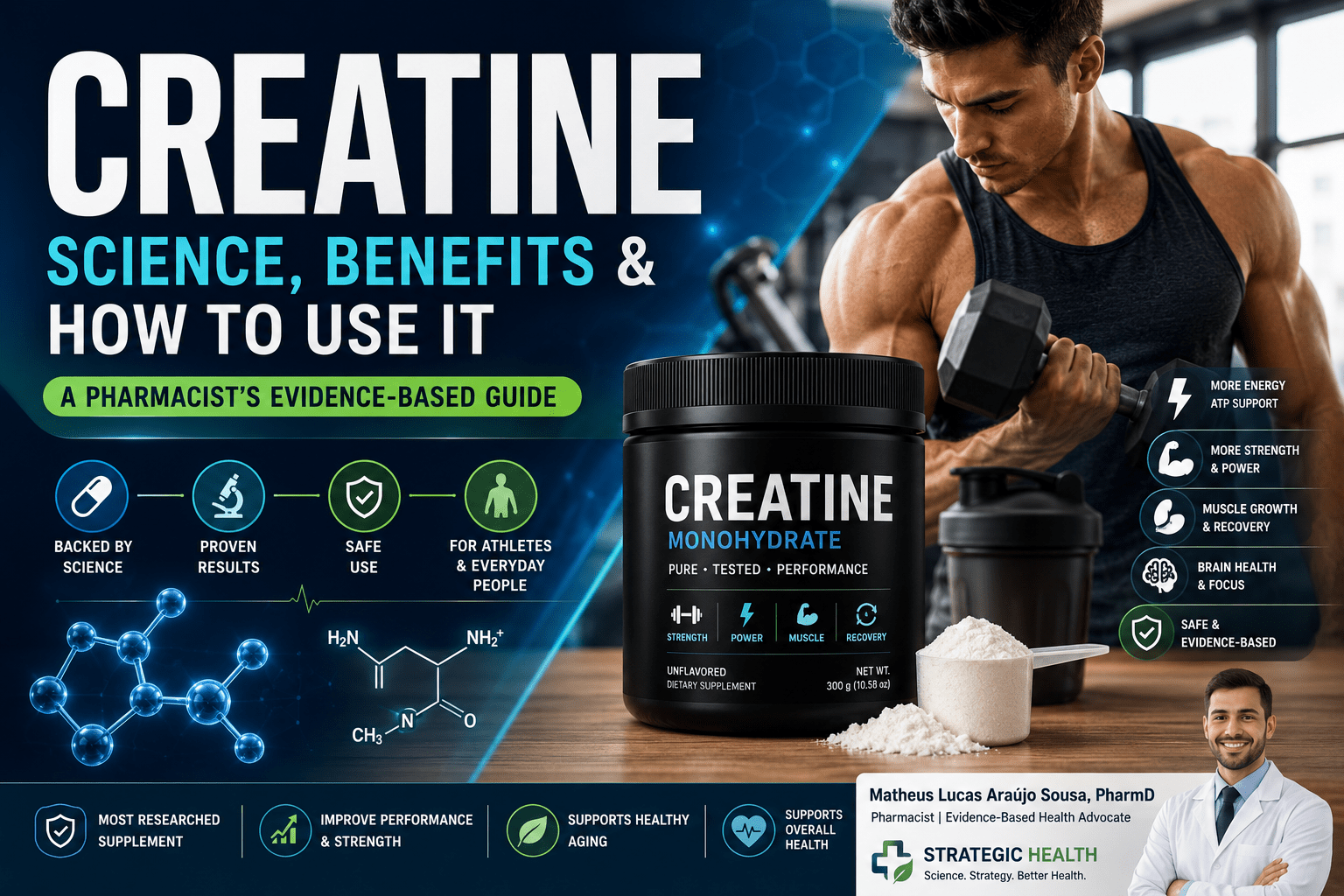
Creatine is one of the most extensively researched dietary supplements in modern medicine and sports nutrition. Despite being widely associated with bodybuilding and athletes, its physiological role extends far beyond muscle growth.
Creatine is a naturally occurring compound synthesized by the human body from three amino acids:
- Glycine
- Arginine
- Methionine
Approximately 1–2 grams of creatine are produced daily, primarily in the liver, kidneys, and pancreas. Another 1–2 grams can be obtained through foods such as red meat and fish.
Once produced or consumed, creatine travels through the bloodstream and is stored mainly in skeletal muscle, where nearly 95% of the body’s total creatine reserve is located. The remaining 5% is distributed among the brain, heart, and other organs that require rapid energy production.
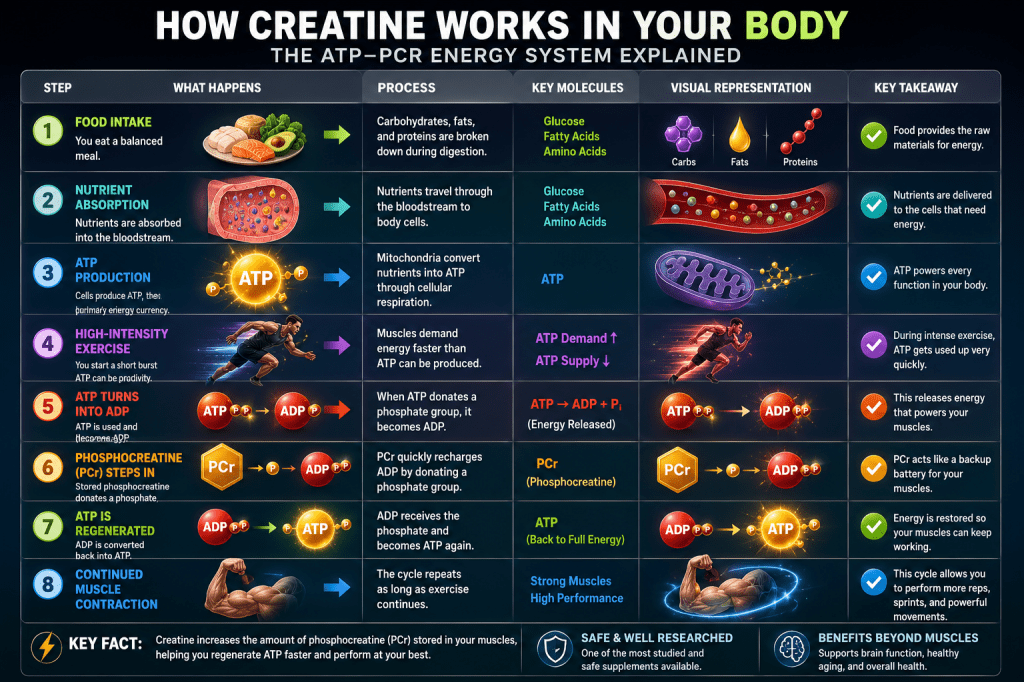
Its primary role is simple yet essential: helping cells regenerate ATP—the body’s universal energy currency.
⚡ Why Does the Body Need Creatine?
Every movement, heartbeat, nerve impulse, and muscle contraction requires energy.
This energy comes from a molecule called adenosine triphosphate (ATP).
However, ATP stores inside the body are extremely limited.
During intense physical activity, ATP can be depleted within just a few seconds.
To maintain performance, the body needs a rapid mechanism to regenerate ATP—and this is where creatine becomes indispensable.
Creatine is stored inside muscles as phosphocreatine (PCr).
When ATP levels begin to fall, phosphocreatine donates its phosphate group to ADP (adenosine diphosphate), rapidly regenerating ATP.
This reaction enables muscles to continue producing force during high-intensity activities
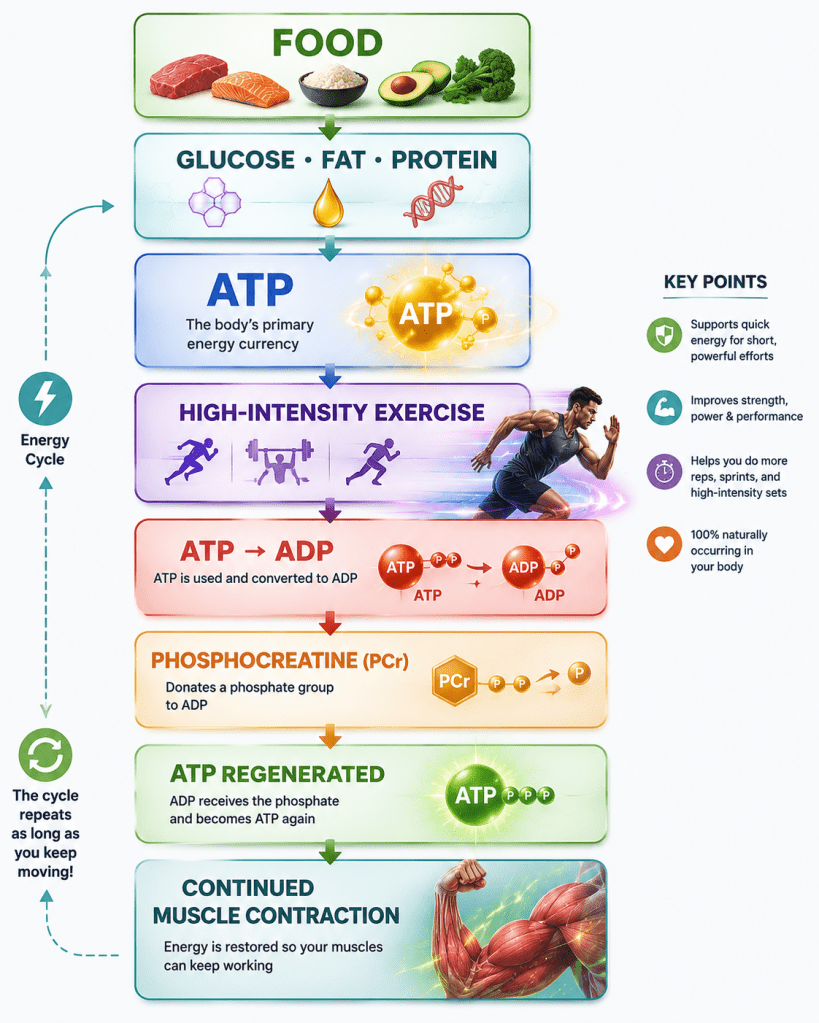
This ATP-PCr system is the body’s fastest pathway for energy regeneration and is especially important during short bursts of maximal effort.
💪 Where Is Creatine Stored?
Around 95% of creatine is stored in skeletal muscles.
The remaining amount is found in tissues with high energy demands, including:
🧠 Brain
❤️ Heart
🩺 Kidneys
🦴 Other metabolically active tissues
Because these organs rely heavily on ATP, researchers have investigated creatine’s potential role beyond sports performance, including cognitive health and healthy aging.
🍖 Natural Sources of Creatine
Although the body synthesizes creatine naturally, dietary intake also contributes to maintaining creatine stores.
Foods naturally rich in creatine include:
Individuals following vegetarian or vegan diets generally consume very little dietary creatine, which explains why they often respond particularly well to supplementation.
🏋️ Why Athletes Use Creatine
High-intensity activities rely predominantly on the ATP-PCr energy system.
Examples include:
🏃 Sprinting
🏋️ Weightlifting
⚽ Soccer
🏀 Basketball
🎾 Tennis
🥊 Combat sports
CrossFit®
Olympic lifting
Because creatine helps regenerate ATP more rapidly, supplementation may improve performance during repeated bouts of intense exercise.
This can allow athletes to perform additional repetitions, maintain higher training intensity, and accumulate greater training volume over time—factors associated with improved strength and muscle development.
🧠 Creatine Is More Than a Sports Supplement
Although creatine became popular through bodybuilding, research has expanded considerably over the past two decades.
Scientists are currently investigating its potential role in:
- Healthy aging
- Brain energy metabolism
- Cognitive performance
- Muscle preservation in older adults
- Neuromuscular health
- Recovery after exercise
- Metabolic health
These areas remain under active investigation, and while many findings are promising, evidence varies depending on the specific condition being studied.
👴 Who May Have Lower Creatine Stores?
Certain populations may naturally have lower creatine reserves or greater requirements, including:
✅ Older adults
✅ Vegetarians
✅ Vegans
✅ Individuals with low meat intake
✅ Elite athletes engaged in high-volume training
For these groups, supplementation may increase muscle creatine stores more substantially than in individuals whose baseline levels are already high.
🧪 Is Creatine a Steroid?
No.
This is one of the most common misconceptions.
Creatine is not an anabolic steroid, hormone, or performance-enhancing drug in the pharmacological sense.
Instead, it is a naturally occurring nutrient found in foods and produced by the body.
Its mechanism of action is based on supporting the body’s normal energy systems rather than altering hormone levels.
As a result, creatine is widely recognized as one of the safest and most effective dietary supplements available when used appropriately.
🔍 Key Takeaways
✔ Creatine is naturally produced by the body.
✔ It is stored mainly in skeletal muscle.
✔ Its primary role is rapid ATP regeneration.
✔ It supports high-intensity exercise performance.
✔ It is not a steroid.
✔ It is found naturally in meat and fish.
✔ Research continues to explore benefits beyond athletic performance.
✅ Conclusion
Creatine is one of the most thoroughly researched dietary supplements in modern science and remains the gold standard for improving high-intensity exercise performance. Its essential role in rapidly regenerating adenosine triphosphate (ATP)—the body’s primary energy currency—makes it a key nutrient for athletes, physically active individuals, and, increasingly, for healthy aging.
Over the past three decades, hundreds of clinical studies have demonstrated that creatine monohydrate is effective for increasing muscle strength, enhancing power output, supporting lean muscle mass, and improving recovery from repeated bouts of intense exercise. More recently, scientific interest has expanded beyond sports nutrition, with research exploring its potential role in cognitive function, neuromuscular health, metabolic health, and the preservation of muscle mass during aging.
Current evidence consistently shows that creatine is safe for healthy individuals when used at recommended doses and under the guidance of qualified healthcare professionals. Nevertheless, supplementation should never replace the foundations of good health. A balanced diet, regular physical activity, restorative sleep, adequate hydration, and personalized medical care remain the cornerstones of long-term wellness.
As scientific knowledge continues to evolve, creatine stands out not only as a performance supplement but also as an excellent example of how evidence-based nutrition can support human health across different stages of life.
Making informed decisions based on reliable scientific evidence empowers individuals to improve their quality of life while avoiding myths and misinformation surrounding dietary supplements.
👨⚕️ About the Author
Matheus Lucas Araújo Sousa, PharmD
Licensed Pharmacist with a passion for evidence-based healthcare, clinical pharmacology, and nutritional science.
Through Strategic Health, my mission is to translate complex scientific research into practical, accurate, and accessible information that helps readers make informed decisions about their health.
I believe that education is one of the most powerful tools for disease prevention and health promotion. Every article published is carefully developed using current scientific literature and internationally recognized clinical guidelines to ensure accuracy, clarity, and credibility.
Thank you for reading.
If you found this article helpful, consider sharing it with friends and family, and explore our growing collection of evidence-based articles on nutrition, supplements, preventive medicine, and healthy living.
⚠️ Medical Disclaimer
The information presented in this article is intended solely for educational and informational purposes. It should not be interpreted as medical advice, diagnosis, or treatment.
Always consult your physician, pharmacist, registered dietitian, or another qualified healthcare professional before starting any dietary supplement, especially if you have a medical condition, are pregnant or breastfeeding, or are taking prescription medications.
📚 Scientific References
- International Society of Sports Nutrition. Kreider RB, et al. International Society of Sports Nutrition Position Stand: Safety and Efficacy of Creatine Supplementation in Exercise, Sport, and Medicine. Journal of the International Society of Sports Nutrition. 2022.
- National Institutes of Health. Office of Dietary Supplements. Dietary Supplements Fact Sheets.
- PubMed. Peer-reviewed publications on creatine metabolism, exercise physiology, and clinical nutrition.
- American College of Sports Medicine. Scientific resources on exercise performance and sports nutrition.
- European Food Safety Authority. Scientific Opinion on Creatine and Physical Performance.
- Cochrane. Systematic reviews evaluating nutritional interventions and exercise performance.
- Journal of the International Society of Sports Nutrition. Reviews on creatine supplementation, muscle physiology, and healthy aging.
 saudeestrategicaart