Meta Description: Discover the science behind Coenzyme Q10 (CoQ10), including its health benefits, recommended dosage, safety, side effects, and who may benefit most from supplementation.
Coenzyme Q10 (CoQ10): The Essential Nutrient for Cellular Energy
⚡ Every heartbeat, every muscle contraction, and every thought requires energy.
That energy is produced inside tiny structures called mitochondria, often referred to as the powerhouses of our cells.
One molecule plays a central role in this process:
Coenzyme Q10 (CoQ10).
CoQ10 is a naturally occurring antioxidant that helps produce adenosine triphosphate (ATP)—the body’s primary energy currency.
Although our bodies produce CoQ10 naturally, levels gradually decline with age and may also decrease due to certain medications and chronic health conditions.
As a result, CoQ10 supplementation has become one of the most researched nutritional strategies for supporting heart health, energy production, and healthy aging.
What Is Coenzyme Q10?
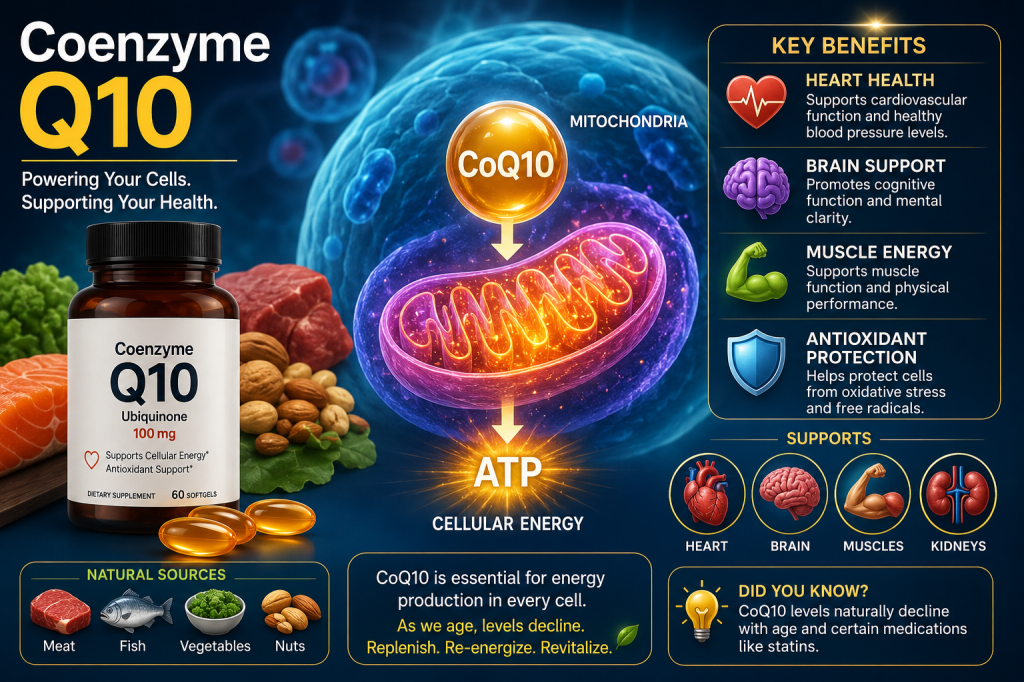
Coenzyme Q10 (CoQ10), also known as ubiquinone, is a fat-soluble compound present in virtually every cell of the body.
Its primary functions include:
✅ ATP production
✅ Antioxidant protection
✅ Mitochondrial function
✅ Cellular repair
The highest concentrations are found in organs with high energy demands:
❤️ Heart
🧠 Brain
💪 Skeletal muscles
🫘 Kidneys
🫁 Liver
How Does CoQ10 Work?
Food Intake + Natural Production
⬇️
Coenzyme Q10
⬇️
Mitochondria
⬇️
ATP Production
⬇️
Cellular Energy
⬇️
❤️ Heart • 🧠 Brain • 💪 Muscles • 🫘 Kidneys
Health Benefits of CoQ10
❤️ 1. Supports Heart Health
The heart requires enormous amounts of energy.
Several clinical studies suggest CoQ10 supplementation may:
• Support normal cardiac function
• Improve mitochondrial energy production
• Help reduce oxidative stress
• Support healthy blood vessel function
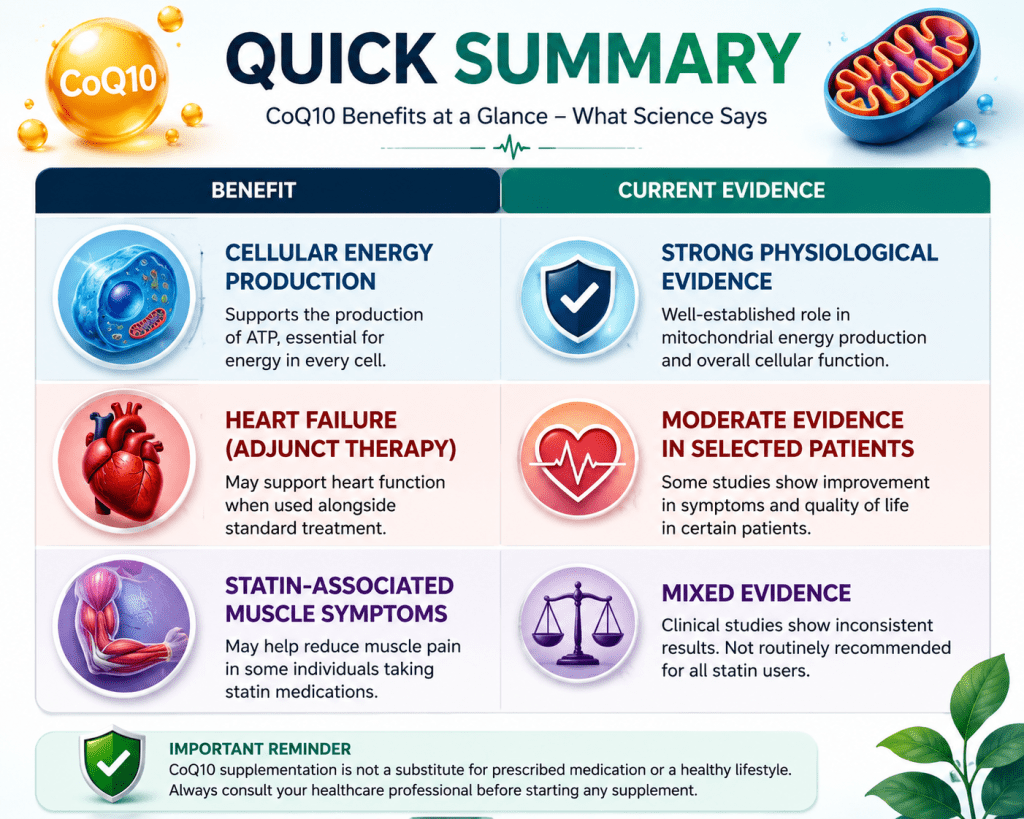
Research also suggests CoQ10 may improve quality of life in people with heart failure when used alongside standard medical treatment.
⚡ 2. Helps Reduce Fatigue
Low CoQ10 levels have been associated with:
• Physical fatigue
• Reduced exercise tolerance
• Low energy
Supplementation may improve cellular energy production, especially in individuals with deficiency.
💪 3. Exercise Performance
CoQ10 may help:
• Improve muscle recovery
• Reduce oxidative stress during exercise
• Enhance endurance in some individuals
Although benefits vary, athletes and active adults commonly use CoQ10 for recovery support.
🧠 4. Brain Health
The brain consumes nearly 20% of the body’s total energy.
Because CoQ10 acts as an antioxidant, researchers continue investigating its potential role in supporting neurological health and healthy aging.
Evidence is promising, although more high-quality clinical studies are needed.
👵 5. Healthy Aging
As we age:
• Natural CoQ10 production declines
• Oxidative stress increases
• Mitochondrial efficiency decreases
Supplementation may help maintain cellular function during aging.
CoQ10 and Statins
One of the most discussed topics is the relationship between statins and CoQ10.
Statins lower cholesterol by inhibiting an enzyme involved in cholesterol synthesis.
The same pathway is also involved in producing CoQ10.
Some people taking statins may experience lower CoQ10 levels.
Although research is mixed, some studies suggest supplementation may help reduce statin-associated muscle symptoms in certain individuals.
Patients should always consult their healthcare provider before starting supplements.
Food Sources of CoQ10
Although supplements provide larger doses, several foods naturally contain CoQ10.
🥩 Beef
🐟 Salmon
🐟 Sardines
🐔 Chicken
🥜 Peanuts
🌰 Pistachios
🥦 Broccoli
🥬 Spinach
🫒 Soybean oil
Because food contains relatively small amounts, supplementation may be appropriate when higher intake is desired.
Recommended Dosage
Clinical studies commonly use:
✅ 30–100 mg/day for general wellness
✅ 100–200 mg/day for cardiovascular support
✅ Up to 300 mg/day under professional supervision
Because CoQ10 is fat-soluble, it is best absorbed when taken with meals containing healthy fats.
Ubiquinone vs. Ubiquinol
There are two primary supplemental forms:
Ubiquinone
• Traditional form
• Extensive clinical research
• Usually less expensive
Ubiquinol
• Reduced (active) form
• May have greater bioavailability in older adults
• Typically more expensive
Both forms can effectively increase blood CoQ10 levels.
Possible Side Effects
CoQ10 is generally well tolerated.
Occasional side effects may include:
• Mild stomach discomfort
• Nausea
• Diarrhea
• Headache
• Insomnia (if taken late at night)
Serious adverse effects are uncommon.
Who Should Talk to a Healthcare Professional Before Taking CoQ10?
Speak with a healthcare professional if you:
✔ Take blood thinners (such as warfarin)
✔ Are pregnant or breastfeeding
✔ Have chronic medical conditions
✔ Take prescription medications
✔ Have recently undergone surgery
Frequently Asked Questions
Does CoQ10 increase energy immediately?
No. Benefits generally develop gradually over several weeks.
Is CoQ10 safe?
Current evidence suggests CoQ10 has an excellent safety profile when used appropriately.
Can healthy adults take CoQ10?
Many healthy adults choose CoQ10 supplementation, although not everyone requires it.
Is CoQ10 good for athletes?
Some studies suggest improved recovery and reduced oxidative stress, though responses vary.
Key Takeaways
✔ Supports mitochondrial ATP production
✔ Powerful antioxidant
✔ Supports cardiovascular health
✔ May help reduce fatigue
✔ Supports healthy aging
✔ Generally safe with appropriate use
✔ Best absorbed with meals containing fat
Conclusion
Coenzyme Q10 is one of the most extensively studied nutritional supplements for cellular energy production and antioxidant protection. Its role in mitochondrial function makes it particularly relevant for tissues with high energy demands, including the heart, brain, muscles, and kidneys.
Current scientific evidence suggests that CoQ10 supplementation may support cardiovascular health, reduce oxidative stress, and improve energy metabolism in specific populations, particularly older adults and individuals with lower endogenous levels. While research continues to evolve, CoQ10 has demonstrated a strong safety profile and remains a valuable option when used appropriately under professional guidance.
Maintaining a balanced diet, regular physical activity, and individualized medical advice should always remain the foundation of long-term health. Supplements such as CoQ10 are intended to complement—not replace—a healthy lifestyle and evidence-based medical care.
References
- Mortensen SA, Rosenfeldt F, Kumar A, et al. The Effect of Coenzyme Q10 on Morbidity and Mortality in Chronic Heart Failure (Q-SYMBIO Study). JACC Heart Failure. 2014.
- Alehagen U, Johansson P, Björnstedt M, et al. Cardiovascular mortality and Coenzyme Q10 supplementation. International Journal of Cardiology. 2015.
- National Institutes of Health (NIH). Office of Dietary Supplements. Coenzyme Q10 Fact Sheet.
- Mayo Clinic. Coenzyme Q10: Uses and Safety.
- European Food Safety Authority (EFSA). Scientific opinions on Coenzyme Q10.
- Bhagavan HN, Chopra RK. Coenzyme Q10: Absorption, Tissue Uptake, Metabolism and Pharmacokinetics. Free Radical Research.
- Crane FL. Biochemical Functions of Coenzyme Q10. Journal of the American College of Nutrition.
About the Author
Matheus Lucas Araújo Sousa, PharmD
💊 Pharmacist | Evidence-Based Health Content Creator
Dedicated to translating complex scientific evidence into practical, reliable health information to help readers make informed decisions.
Strategic Health
Evidence-based health information for better living.
 saudeestrategicaart