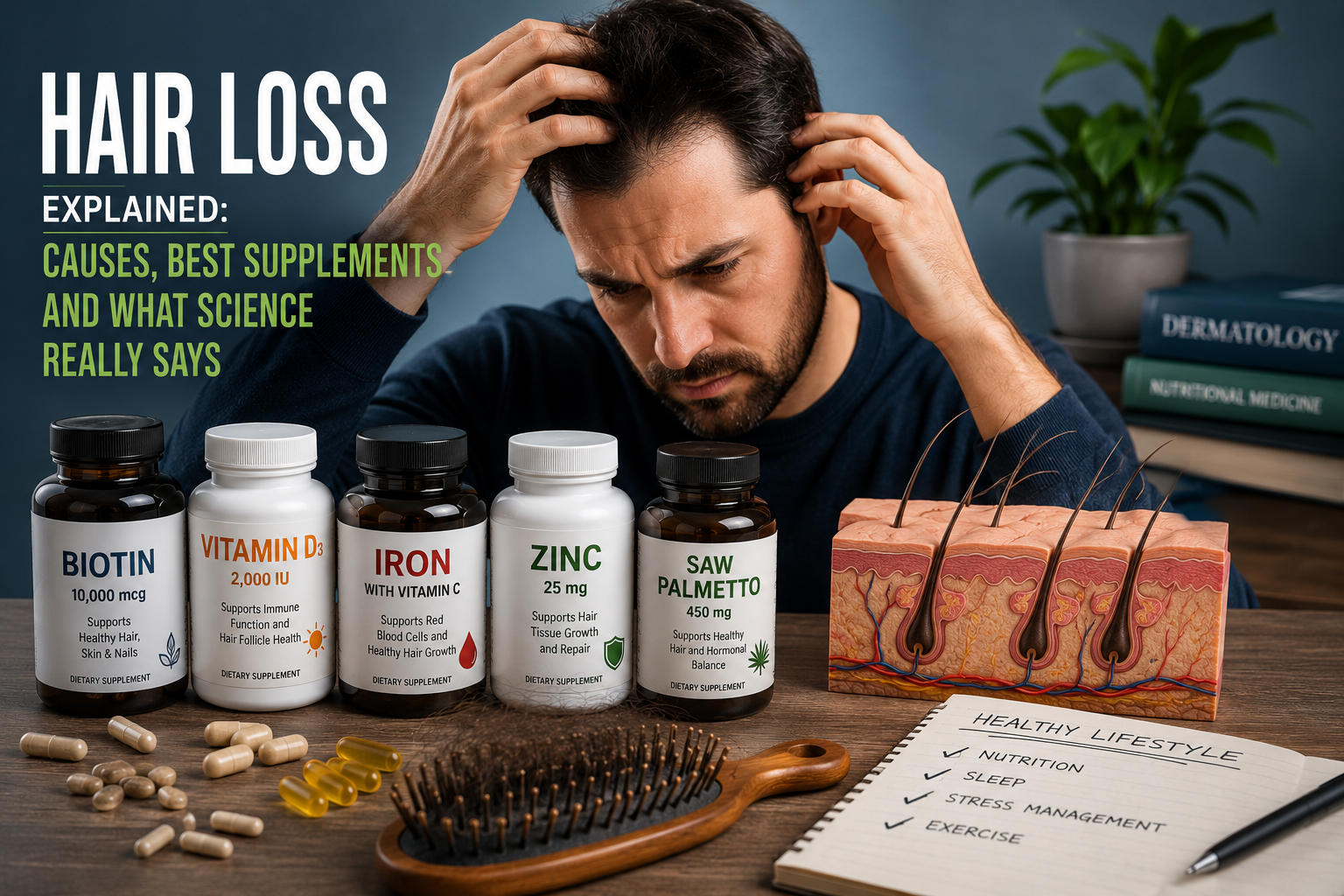
Evidence-Based Guide to Hair Loss, Hair Growth and Nutritional Support

Part 1 — Understanding Hair Loss and the Hair Growth Cycle
💇 Introduction
Hair loss is one of the most common health concerns worldwide, affecting millions of men and women of all ages. Although losing some hair every day is completely normal, excessive shedding may indicate nutritional deficiencies, hormonal imbalances, chronic stress, underlying medical conditions, medication effects, or genetic predisposition.
According to the American Academy of Dermatology, healthy adults naturally lose 50–100 hairs each day as part of the normal hair growth cycle. Problems arise when this balance is disrupted and hair falls faster than it can regrow.
Fortunately, scientific research has greatly improved our understanding of hair biology over the past decade. Today, clinicians recognize that successful hair management often requires identifying the underlying cause rather than relying solely on cosmetic products or supplements.
This evidence-based guide explains:
- 🧬 How hair grows
- 🔄 Why hair falls out
- 🩺 The most common medical causes
- 🥗 How nutrition influences hair health
- 💊 Which supplements may actually help
- 🔬 What current scientific evidence really says
🧬 Understanding Hair Biology
Hair is much more than a cosmetic feature. It is a biologically active structure produced by specialized cells within the hair follicle, one of the body’s fastest-growing tissues.
Each follicle continuously cycles through periods of:
- Active growth
- Regression
- Resting
- Shedding
Because hair follicles are highly metabolically active, they require:
✅ Adequate protein intake
✅ Vitamins
✅ Minerals
✅ Healthy blood circulation
✅ Balanced hormone levels
✅ Proper mitochondrial energy production
Even temporary disruptions in these systems may trigger noticeable hair shedding.
🔄 The Hair Growth Cycle
Every individual hair follows a repeating biological cycle consisting of four phases.

🧠 Key Point
Healthy hair depends not only on growing new strands but also on maintaining a high percentage of follicles in the anagen (growth) phase. Many forms of hair loss occur because follicles enter the telogen phase prematurely.
📉 Why Does Hair Loss Occur?
Hair loss develops when the normal balance between growth and shedding is disturbed.
This may happen because:
- 🧬 Genetics
- ⚖️ Hormonal changes
- 🥗 Nutritional deficiencies
- 🔥 Chronic inflammation
- 😰 Psychological stress
- 💊 Certain medications
- 🦠 Illness
- 💤 Poor sleep
- 🚬 Smoking
- ☀️ Aging
In many individuals, several factors act together rather than a single isolated cause.
🔍 The Most Common Causes of Hair Loss
🧬 1. Androgenetic Alopecia (Pattern Hair Loss)
The most common cause worldwide.
Characteristics:
- Family history
- Progressive thinning
- Hormonal sensitivity to dihydrotestosterone (DHT)
- Miniaturization of hair follicles
- Usually develops gradually over years
😰 2. Telogen Effluvium
Occurs when a large number of hairs enter the resting phase simultaneously.
Common triggers include:
- Major illness
- High fever
- Surgery
- Childbirth
- Rapid weight loss
- Severe emotional stress
- Nutritional deficiencies
Hair shedding often begins 2–4 months after the triggering event.
🦠 3. Alopecia Areata
An autoimmune condition in which the immune system mistakenly attacks hair follicles.
Typical features:
- Round bald patches
- Sudden onset
- Can affect beard, eyebrows and scalp
- May resolve spontaneously or recur
🧪 4. Nutritional Deficiencies
Hair follicles require continuous nutrient availability.
Deficiencies associated with hair shedding include:
- Iron
- Zinc
- Vitamin D
- Protein
- Biotin (mainly in true deficiency)
- Vitamin B12
- Folate
Not every individual with hair loss has nutrient deficiencies, which is why supplementation should ideally be guided by clinical evaluation.
💊 5. Medication-Induced Hair Loss
Several medications may contribute to increased shedding.
Examples include:
- Certain anticoagulants
- Some antidepressants
- Retinoids
- Chemotherapy drugs
- Some blood pressure medications
- Certain anticonvulsants
Hair often regrows after the medication is discontinued or adjusted under medical supervision.
⚠️ Risk Factors
Several lifestyle and medical factors increase the likelihood of developing hair loss.

👨 Men’s Hair Loss vs 👩 Women’s Hair Loss
Although many mechanisms overlap, hair loss often presents differently in men and women.

📊 Table — Common Causes of Hair Loss

Part 2 – Evidence-Based Supplements for Hair Health
🌿 Can Supplements Really Help Hair Growth?
One of the most common questions in dermatology and nutritional science is whether supplements can truly reduce hair loss or stimulate new hair growth.
The scientific answer is:
It depends on the cause of the hair loss.
Supplements are not miracle treatments, but they can significantly improve hair growth when nutritional deficiencies, increased physiological demands, or specific metabolic problems are involved.
If hair loss is caused by:
- 🩸 Iron deficiency
- 🥩 Low protein intake
- ☀️ Vitamin D deficiency
- 🧬 Zinc deficiency
- 🧠 Chronic stress
- 🍽️ Poor dietary quality
then correcting these deficiencies often improves hair growth over several months.
However, if hair loss is caused primarily by:
- Genetics (Androgenetic Alopecia)
- Autoimmune diseases
- Scarring alopecia
supplements alone usually have limited effectiveness and should be combined with evidence-based medical treatments under professional supervision.
🔬 The Supplements with the Strongest Scientific Evidence
Not every supplement marketed for hair health has strong clinical evidence.
Current research consistently supports only a limited number of nutrients.
🧬 1. Biotin (Vitamin B7)
Biotin is probably the most famous hair supplement worldwide.
What does it do?
Biotin participates in:
- Keratin production
- Fat metabolism
- Amino acid metabolism
- Cellular growth
Hair follicles require keratin synthesis to produce strong hair fibers.
Does everyone need Biotin?
Interestingly…
No.
Biotin deficiency is actually uncommon.
Most healthy adults obtain sufficient biotin through:
🥚 Eggs
🥜 Nuts
🥛 Dairy
🐟 Fish
🥩 Meat
When supplementation may help
Scientific evidence supports biotin supplementation mainly for individuals with:
✔ Confirmed biotin deficiency
✔ Pregnancy
✔ Certain genetic disorders
✔ Long-term antibiotic therapy
✔ Severe malnutrition
For healthy individuals without deficiency, current evidence does not consistently demonstrate meaningful hair growth benefits.
Typical supplemental doses
Clinical supplements commonly contain:
- 30–300 mcg/day (physiological doses)
- 2,500–10,000 mcg/day (commercial hair products)
Higher doses are widely marketed, but they are not necessarily more effective.
⚠ Important Safety Note
Very high doses of biotin may interfere with several laboratory tests, including:
- Thyroid hormones
- Troponin (heart attack tests)
- Hormonal assays
Patients should inform healthcare providers before blood testing.
☀️ 2. Vitamin D
Vitamin D receptors are highly active inside hair follicles.
Research has shown that low Vitamin D levels are associated with:
- Alopecia areata
- Female pattern hair loss
- Chronic telogen effluvium
Vitamin D appears to regulate:
✔ Hair follicle cycling
✔ Immune balance
✔ Stem cell activation
Can Vitamin D reverse hair loss?
Only when deficiency exists.
Individuals with normal Vitamin D levels generally do not experience additional hair growth from supplementation alone.
Main food sources
🐟 Fatty fish
🥚 Egg yolks
🥛 Fortified dairy products
☀️ Sunlight remains the primary natural source.
🩸 3. Iron
Iron deficiency is among the most common nutritional causes of diffuse hair shedding worldwide.
Women are particularly vulnerable because of:
- Menstruation
- Pregnancy
- Increased iron requirements
Low ferritin levels have been associated with:
- Chronic telogen effluvium
- Reduced hair density
- Slower regrowth
Should everyone take iron?
Absolutely not.
Excess iron can be harmful.
Supplementation should ideally follow laboratory confirmation of deficiency.
⚙️ 4. Zinc
Zinc participates in more than 300 enzymatic reactions throughout the body.
For hair follicles, zinc contributes to:
✔ Cell division
✔ Protein synthesis
✔ Tissue repair
✔ Immune regulation
Low zinc levels have been associated with:
- Telogen effluvium
- Alopecia areata
- Brittle hair
Food sources
🥩 Beef
🦪 Oysters
🥜 Pumpkin seeds
🥜 Cashews
🧪 5. Protein
Hair is composed primarily of keratin, a structural protein.
Without sufficient dietary protein, the body prioritizes essential organs over hair production.
Signs of inadequate protein intake may include:
- Hair shedding
- Thin hair
- Slow growth
- Fragile strands
Individuals at greater risk include:
🥗 Strict vegetarians
🌱 Vegans without careful dietary planning
👵 Older adults
⚕ Patients recovering from illness
🧬 6. Omega-3 Fatty Acids
Omega-3 fatty acids help regulate inflammatory pathways throughout the body.
Because chronic inflammation may contribute to certain types of hair loss, Omega-3s have attracted scientific interest.
Potential mechanisms include:
✔ Reduced inflammatory signaling
✔ Improved scalp health
✔ Enhanced skin barrier function
✔ Support for follicle environment
Current evidence is promising but still limited, and Omega-3 should be viewed as a supportive measure rather than a primary treatment for hair loss.
🌿 7. Collagen
Collagen supplements are extremely popular in the beauty industry.
The proposed benefits include:
- Amino acid supply
- Skin support
- Antioxidant peptides
However…
Current clinical evidence does not demonstrate that collagen directly stimulates hair growth.
Any benefit is likely indirect through improved nutritional support rather than specific follicle stimulation.
🌱 8. Saw Palmetto
Saw Palmetto is a botanical extract obtained from the berries of Serenoa repens.
Researchers believe it may reduce conversion of testosterone into dihydrotestosterone (DHT).
Since DHT plays a central role in androgenetic alopecia, Saw Palmetto has been investigated as a natural alternative.
Clinical studies suggest:
✔ Mild improvement in some patients
✔ Generally well tolerated
✔ Less effective than prescription medications such as finasteride
Evidence remains moderate, and larger trials are still needed.
📊 Evidence Ranking of Common Hair Supplements

🧠 Key Takeaways
Evidence-based supplementation works best when it addresses an identified deficiency or a specific biological mechanism contributing to hair loss.
Before starting supplements, consider:
- 🩺 Seeking medical evaluation to determine the underlying cause.
- 🧪 Checking relevant laboratory tests (such as ferritin, vitamin D, thyroid function, and others when indicated).
- 🍎 Prioritizing a balanced diet with adequate protein and micronutrients.
- 💊 Using supplements as part of a broader treatment plan rather than expecting them to work alone.
💇 Hair Loss Explained: Causes, Best Supplements and What Science Really Says
Part 3 – Medical Treatments, Healthy Habits, Common Myths and Evidence-Based Action Plan
💊 Medical Treatments That Actually Work
Although nutritional optimization is essential, some types of hair loss require medical treatment to slow progression and stimulate regrowth.
Current international dermatology guidelines support several evidence-based therapies.
🧴 1. Minoxidil
Minoxidil is one of the most widely studied treatments for hair loss.
Originally developed as a blood pressure medication, researchers discovered it also stimulates hair growth.
How it works
Minoxidil may:
✔ Increase blood flow around hair follicles
✔ Extend the anagen (growth) phase
✔ Promote thicker hair shafts
✔ Increase follicle size over time
Who may benefit?
It is commonly recommended for:
- 👨 Male Pattern Hair Loss
- 👩 Female Pattern Hair Loss
- 🍂 Chronic Telogen Effluvium (selected cases)
Results generally become noticeable after 3–6 months, with optimal improvement often occurring after 6–12 months of consistent use.
💊 2. Finasteride
Finasteride is an oral prescription medication primarily used for male androgenetic alopecia.
It works by inhibiting the enzyme 5-alpha reductase, reducing the conversion of testosterone into dihydrotestosterone (DHT), the hormone largely responsible for progressive follicle miniaturization.
Scientific evidence
Large clinical trials have demonstrated that finasteride can:
✔ Slow hair loss progression
✔ Increase hair density
✔ Improve long-term hair retention in many men
Potential adverse effects and contraindications should always be discussed with a qualified healthcare professional.
💉 3. Dutasteride
Dutasteride is a stronger inhibitor of DHT production than finasteride.
Although approved in some countries for other indications, it is used off-label for hair loss in certain situations under specialist supervision.
Current evidence suggests it may provide greater hair regrowth than finasteride in some patients but may also carry a higher risk of side effects.
🩺 4. Platelet-Rich Plasma (PRP)
PRP therapy involves concentrating platelets from the patient’s own blood and injecting them into the scalp.
Platelets release growth factors that may stimulate dormant follicles.
Research suggests PRP may improve:
✔ Hair density
✔ Hair thickness
✔ Hair shaft diameter
Best results are usually seen when combined with conventional therapies.
🌱 5. Low-Level Laser Therapy (LLLT)
Low-level laser devices deliver specific wavelengths of light that may stimulate follicular activity.
Some clinical studies have reported improvements in:
- Hair density
- Hair thickness
- Overall scalp coverage
Evidence is encouraging, although treatment protocols vary considerably.
🧠 Lifestyle Habits That Support Healthy Hair
Hair follicles are highly metabolically active and respond to overall health.
Healthy lifestyle habits help create an environment that supports normal hair growth.
🍽 Prioritize Nutrient-Dense Foods
A balanced diet should include:
🥩 Lean proteins
🐟 Fatty fish
🥚 Eggs
🥬 Leafy green vegetables
🥜 Nuts and seeds
🍓 Fruits rich in antioxidants
😴 Protect Your Sleep
Hair growth is influenced by hormonal regulation.
Chronic sleep deprivation may contribute to:
- Elevated cortisol
- Increased inflammation
- Greater hair shedding
Adults should aim for 7–9 hours of quality sleep each night.
🏃 Stay Physically Active
Regular exercise supports:
✔ Healthy circulation
✔ Insulin sensitivity
✔ Stress reduction
✔ Cardiovascular health
These factors indirectly benefit scalp health and follicle function.
🧘 Manage Chronic Stress
Persistent stress can trigger telogen effluvium, one of the most common forms of diffuse hair shedding.
Helpful strategies include:
- Meditation
- Mindfulness
- Deep breathing
- Walking outdoors
- Regular physical activity
❌ Common Hair Loss Myths
❌ Myth 1: Washing your hair causes hair loss.
Reality: Washing removes hairs that have already completed their growth cycle. It does not damage healthy follicles.
❌ Myth 2: Wearing hats causes baldness.
Reality: There is no scientific evidence that normal hat use causes androgenetic alopecia.
❌ Myth 3: Cutting hair makes it grow faster.
Reality: Hair grows from the follicle beneath the skin. Cutting the shaft does not change growth rate or follicle activity.
❌ Myth 4: One supplement can cure all hair loss.
Reality: Hair loss has many different causes. Effective treatment depends on identifying and addressing the underlying problem.
📋 Practical Evidence-Based Hair Health Checklist
✅ Eat enough high-quality protein.
✅ Correct confirmed nutrient deficiencies.
✅ Avoid smoking.
✅ Manage stress effectively.
✅ Sleep 7–9 hours each night.
✅ Exercise regularly.
✅ Seek medical evaluation if hair shedding persists for more than three months or is accompanied by scalp inflammation, pain, or patchy bald areas.
⭐ Final Thoughts
Hair loss is often a reflection of overall health rather than an isolated cosmetic concern.
Scientific evidence shows that healthy hair depends on a combination of:
- Balanced nutrition
- Adequate protein intake
- Correction of nutritional deficiencies
- Hormonal balance
- Stress management
- Healthy sleep
- Appropriate medical treatment when indicated
While supplements can play an important role, they are most effective when used to address documented deficiencies or as part of a comprehensive treatment plan.
The best long-term results come from understanding the underlying cause of hair loss and applying evidence-based strategies consistently.
Healthy hair is built through informed decisions, patience, and long-term care—not quick fixes.
📚 References
- American Academy of Dermatology. Hair loss: Diagnosis and treatment.
- European Academy of Dermatology and Venereology. Evidence-based recommendations for alopecia management.
- National Institutes of Health. Office of Dietary Supplements – Biotin, Iron, Vitamin D and Zinc Fact Sheets.
- Cochrane. Interventions for androgenetic alopecia.
- International Society of Hair Restoration Surgery. Medical therapies for hair loss.
- British Association of Dermatologists. Alopecia patient information and treatment guidance.
👨⚕️ About the Author
Matheus Lucas Araújo Sousa, PharmD
Matheus Lucas Araújo Sousa is a Brazilian pharmacist dedicated to translating complex scientific evidence into practical, trustworthy health information. Through Strategic Healths, he publishes evidence-based articles on nutrition, supplementation, preventive medicine, healthy aging, metabolic health, and lifestyle interventions to help readers make informed decisions.
Follow Strategic Healths for more evidence-based content designed to support long-term health and well-being.
🔗 Related Evidence-Based Articles
If you enjoyed this article, you may also like:
- 🧬 Coenzyme Q10 (CoQ10): Benefits, Uses, Dosage, Side Effects, and What Science Really Says
- 🐟 Omega-3 Benefits: What Science Really Says About Heart, Brain, and Longevity
- 🌱 Berberine: Benefits, Uses, Safety, Dosage and What Science Really Says
- 🔥 Insulin Resistance: Early Signs, Diagnosis and Natural Ways to Improve Metabolic Health
- 🧂 Is Unrefined Salt Healthier? What Science Really Says About Sea Salt, Himalayan Salt and Celtic Salt
- 🧬 The Science of Healthy Aging: Evidence-Based Strategies to Slow Aging Naturally
- 🧠 Brain Health and Cognitive Longevity: Habits and Nutrients That Support Healthy Aging
- 😴 Melatonin: Benefits, Dosage, Safety and What Science Really Says
Thank you for reading!
At Strategic Healths, every article is carefully researched using high-quality scientific evidence to help you make informed decisions about your health.
Stay curious. Stay informed. Stay healthy. 🌿
Leave a Reply