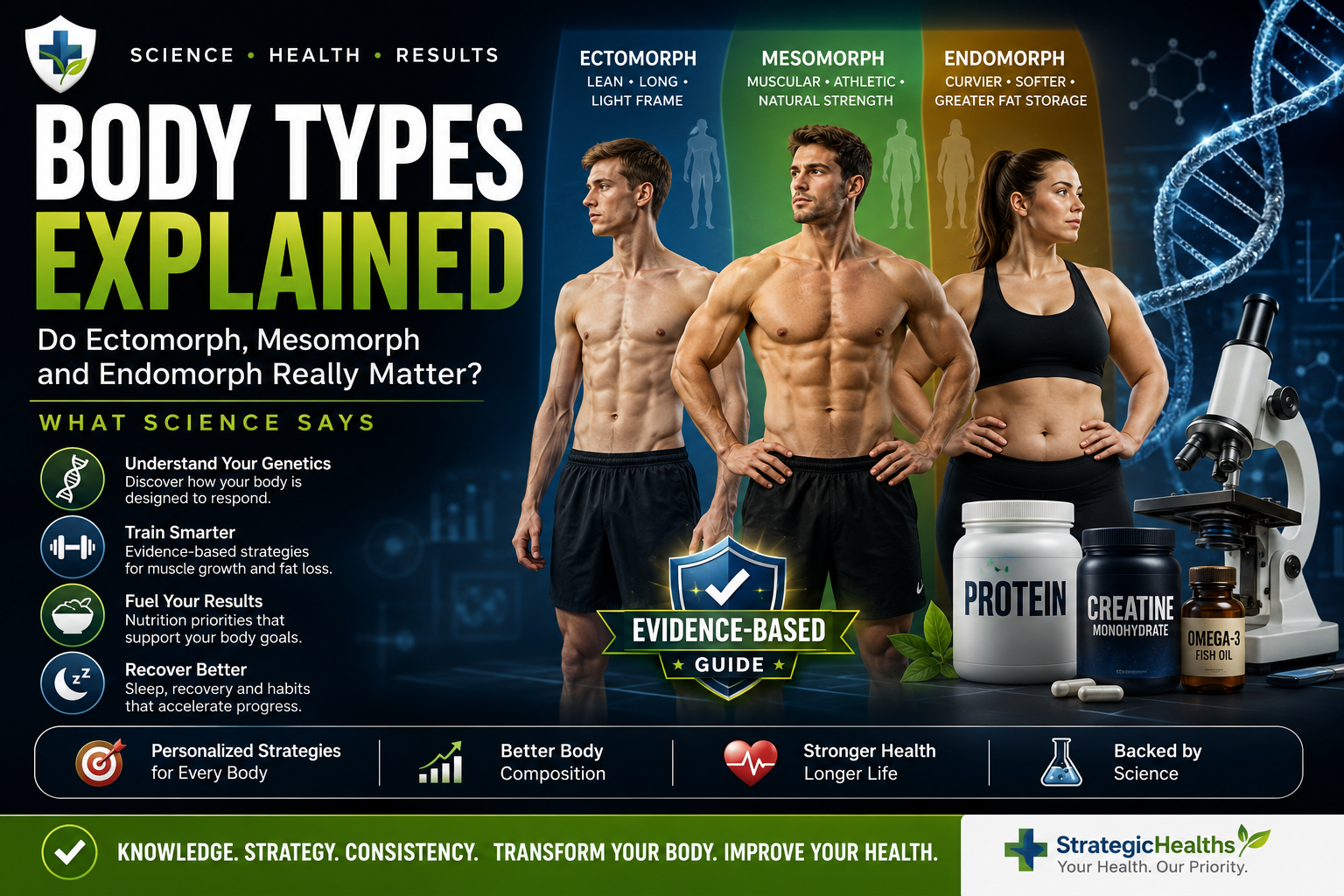

Evidence-Based Guide to Genetics, Muscle Growth, Fat Loss, Metabolism and Training Strategies
PART 1 — The Science Behind Body Types
🧬 Introduction
Have you ever heard someone say:
“I’m an ectomorph, so I can’t build muscle.”
Or perhaps:
“I’m an endomorph—I gain fat just by looking at food.”
These statements are extremely common in gyms, on social media, and across fitness websites. But are they actually supported by modern science?
The concepts of ectomorph, mesomorph, and endomorph have been discussed for decades and continue to influence how many people approach training and nutrition. However, advances in genetics, exercise physiology, and body composition research have revealed that the reality is much more complex.
While body type classifications can provide a simple framework for understanding differences in physique, they should not be viewed as fixed categories or predictors of athletic success.
Today, researchers agree that genetics, training quality, nutrition, sleep, recovery, age, sex, hormones, and long-term consistency have a much greater influence on body composition than body type alone.
This article explores what science really says about body types, helping you separate useful concepts from outdated myths.
🧬 What Are Body Types?
Body types—also known as somatotypes—are a system used to describe general differences in human physique.
Rather than classifying people as healthy or unhealthy, the system attempts to categorize common physical characteristics such as:
- Height
- Bone structure
- Muscle development
- Fat distribution
- Limb proportions
- Overall body shape
Traditionally, three primary somatotypes have been described:
- 🦴 Ectomorph
- 💪 Mesomorph
- ⚖️ Endomorph
These categories were never intended to define a person’s destiny. Instead, they were originally developed as descriptive observations of body shape.
Importantly, modern research indicates that most individuals display characteristics of more than one somatotype, making body type better understood as a continuum rather than three distinct groups.
📊 Table 1 – Overview of the Three Classical Body Types

Evidence Note: These characteristics describe common physical traits—not biological rules or guaranteed outcomes.
📜 The History of Somatotypes
The somatotype concept dates back to the 1940s.
American psychologist William Herbert Sheldon proposed that body shape could be grouped into three main categories and suggested that each body type was associated with specific personality traits.
While the body shape classification became widely known, the personality component has been rejected by modern science due to a lack of supporting evidence.
Today, researchers who use somatotypes focus on body composition and anthropometric measurements rather than personality.
👨🔬 William Sheldon and the Original Classification
Sheldon proposed three primary body types:
🦴 Ectomorph
Associated with:
- Slender physique
- Narrow shoulders
- Small joints
- Long arms and legs
- Lower body fat
- Lower muscle mass
💪 Mesomorph
Characterized by:
- Broad shoulders
- Narrow waist
- Greater muscle mass
- Athletic appearance
- Stronger bone structure
⚖️ Endomorph
Typically described as:
- Softer body composition
- Larger hips
- Greater fat storage
- Wider waist
- Larger bone structure in many individuals
Although these descriptions remain widely recognized, modern evidence emphasizes that they should be viewed as general tendencies rather than strict categories.
📊 Table 2 – Classical Somatotype Characteristics

🦴 Ectomorph
People commonly described as ectomorphs often have:
✅ Long limbs
✅ Narrow shoulders
✅ Lower body weight
✅ Smaller joints
✅ Lean appearance
Contrary to popular belief, being naturally lean does not prevent muscle growth.
With progressive resistance training, sufficient protein intake, adequate calorie consumption, and consistent recovery, ectomorphic individuals can develop substantial muscle mass.
Many elite athletes classified as “ectomorphic” have successfully built exceptional physiques through years of structured training.
💪 Mesomorph
Mesomorphs are often viewed as the “ideal” athletic body type.
Common characteristics include:
- Naturally muscular appearance
- Broad shoulders
- Narrow waist
- Easier strength gains
- Balanced body composition
However, having mesomorphic characteristics does not eliminate the need for structured training or healthy nutrition.
Muscle growth still depends on:
- Progressive overload
- Adequate protein
- Recovery
- Sleep
- Training consistency
⚖️ Endomorph
Endomorphic traits may include:
- Greater fat storage
- Larger waist circumference
- Rounder body shape
- Wider pelvis
- Higher absolute body mass
These features are often misunderstood.
Modern research shows that body fat accumulation is influenced by numerous factors including:
- Energy intake
- Physical activity
- Sleep
- Genetics
- Hormonal regulation
- Environment
- Socioeconomic factors
Being classified as an endomorph does not mean someone is destined to remain overweight.
📊 Table 3 – Common Myths vs Scientific Evidence

🧩 Can You Be a Combination of Body Types?
Absolutely.
Most people do not fit perfectly into one category.
For example, someone may have:
- Broad shoulders (mesomorphic trait)
- Long limbs (ectomorphic trait)
- Higher abdominal fat storage (endomorphic trait)
This mixed presentation is far more common than a “pure” body type.
For this reason, many exercise scientists consider somatotypes descriptive rather than diagnostic.
📊 Table 4 – Mixed Body Type Examples

🧬 Body Type vs Genetics
Genetics influence many characteristics related to physique, including:
- Height
- Bone dimensions
- Muscle fiber distribution
- Fat distribution
- Hormonal responses
- Appetite regulation
- Basal metabolic rate
However, genetics interact continuously with lifestyle factors.
Regular resistance training, balanced nutrition, adequate sleep, and sustained healthy habits can substantially modify body composition over time, regardless of someone’s starting physique.
🔥 Body Type vs Metabolism
A common misconception is that body type alone determines metabolic speed.
In reality, resting energy expenditure is influenced primarily by:
- Lean body mass
- Age
- Biological sex
- Hormonal status
- Physical activity
- Overall body size
Individuals with more muscle generally expend more energy at rest than those with less muscle, regardless of whether they identify as ectomorphic, mesomorphic, or endomorphic.
Therefore, metabolism cannot be accurately predicted based solely on body type.
📊 Table 5 – What Actually Influences Body Composition?

✅ Key Takeaways
✔️ Body types describe general physical characteristics rather than fixed biological categories.
✔️ Most individuals exhibit a combination of ectomorphic, mesomorphic, and endomorphic traits.
✔️ Modern evidence does not support the idea that body type alone determines muscle-building potential, fat loss, or athletic performance.
✔️ Genetics play an important role, but training, nutrition, recovery, sleep, and long-term adherence have a greater influence on body composition and health outcomes.
✔️ Understanding body types can be useful for education and self-awareness, but individualized lifestyle strategies remain the cornerstone of achieving fitness and health goals.
🧬 PART 2 — What Science Really Says About Body Types
Modern Evidence on Somatotypes, Muscle Growth, Fat Loss and Athletic Performance
Concepts
The concepts of ectomorph, mesomorph, and endomorph have influenced fitness culture for decades. Many training programs, diet plans, and even supplement advertisements still claim that your body type determines how easily you gain muscle or lose fat.
However, modern research in exercise physiology, genetics, sports nutrition, and body composition tells a much more nuanced story.
Today’s evidence indicates that while genetics contribute to differences in body shape and physical characteristics, training quality, nutrition, recovery, sleep, and long-term consistency are far stronger predictors of success than body type alone.
Understanding this distinction helps avoid unrealistic expectations and allows individuals to focus on factors they can actually improve.
🔬 Are Body Types Scientifically Accurate?
The answer is partially.
The original somatotype classification was intended as a descriptive model rather than a biological law.
Modern exercise science recognizes that:
✅ People naturally differ in skeletal structure.
✅ Genetics influence muscle fiber composition.
✅ Fat distribution varies between individuals.
✅ Some people naturally gain muscle or fat more easily than others.
However…
❌ No scientific evidence supports the idea that body type alone determines your ability to build muscle or lose fat.
Instead, body composition results from a complex interaction between genetics and lifestyle.
📌 Key Point
Think of body type as your starting point—not your destination.
🧬 Modern Research on Somatotypes
Recent research has shifted the focus away from rigid body-type classifications.
Instead, scientists evaluate variables such as:
🧬 Lean body mass
🦴 Bone mineral density
🏋️ Muscle cross-sectional area
🔥 Resting energy expenditure
🧪 Hormonal profile
🍎 Nutritional intake
😴 Recovery quality
🏃 Physical activity level
This approach provides a far more accurate picture of how the body responds to exercise than assigning someone to a single body type.
📊 What Modern Science Prioritizes

💪 Muscle Growth
One of the biggest myths is that ectomorphs cannot gain muscle.
Scientific evidence consistently shows that muscle hypertrophy depends primarily on:
🏋️ Progressive overload
🥩 Adequate protein intake
🔥 Sufficient energy availability
😴 Sleep quality
💧 Recovery
📈 Training consistency
Regardless of body type, muscles grow through the same biological process.
🧬 The Muscle Growth Process
Training
⬇️
Mechanical tension
⬇️
Muscle protein synthesis
⬇️
Repair
⬇️
Adaptation
⬇️
Muscle growth
This pathway occurs in everyone.
The difference lies mainly in how quickly and to what extent individuals respond—not whether they are capable of responding.
🔥 Fat Loss
Another common misconception is that endomorphs cannot lose fat.
Scientific evidence strongly disagrees.
Fat loss occurs whenever long-term energy expenditure exceeds energy intake while preserving lean mass through adequate nutrition and resistance training.
Important contributors include:
🔥 Calorie balance
🚶 Daily movement
🏋️ Resistance training
🥩 High-protein diet
😴 Sleep
😊 Stress management
Body type may influence fat distribution patterns, but it does not eliminate the body’s ability to lose fat.
📊 Major Determinants of Fat Loss

🧪 Hormones
Hormones are often blamed for body type differences.
While hormones certainly influence body composition, they do not create fixed categories of ectomorph, mesomorph, or endomorph.
Key hormones include:
🧬 Testosterone
💉 Insulin
🔥 Thyroid hormones
😴 Cortisol
💪 Growth hormone
🍽️ Leptin
🥗 Ghrelin
These hormones respond to lifestyle, nutrition, exercise, sleep, stress, and medical conditions.
📊 Hormones and Their Main Roles

🔥 Basal Metabolic Rate (BMR)
Many people believe ectomorphs have a “fast metabolism.”
This is only partly true.
Resting metabolic rate depends primarily on:
✔️ Lean body mass
✔️ Height
✔️ Weight
✔️ Sex
✔️ Age
✔️ Hormonal status
Individuals with more muscle naturally burn more calories at rest because muscle tissue requires energy to maintain.
📌 Scientific Insight
Adding muscle through resistance training can modestly increase daily energy expenditure over time, regardless of body type.
📍 Body Fat Distribution
Genetics influence where fat is stored more than whether it is stored.
Common patterns include:
🍎 Android pattern (more abdominal fat)
🍐 Gynoid pattern (hips and thighs)
These patterns are influenced by:
🧬 Genetics
⚖️ Sex hormones
🎂 Age
🧪 Medical conditions
Lifestyle still plays a central role in overall body fat levels.
🏋️ Training Response
No two individuals respond identically to exercise.
Some people gain muscle faster.
Others improve endurance more rapidly.
Others lose fat more efficiently.
Modern research refers to these differences as individual variability, not simply body type.
Training response depends on:
🏋️ Program design
📈 Progressive overload
🥩 Nutrition
😴 Sleep
🧬 Genetics
🔄 Recovery
📅 Consistency
📊 Training Response Factors

❌ Common Myths
❌ Myth 1
“Ectomorphs can’t gain muscle.”
Reality: They absolutely can, although some may require more time, sufficient calories, and consistent resistance training.
❌ Myth 2
“Mesomorphs don’t need to train hard.”
Reality: Muscle growth still depends on progressive overload, nutrition, and recovery.
❌ Myth 3
“Endomorphs can’t get lean.”
Reality: Sustainable fat loss is achievable with appropriate dietary habits, physical activity, and long-term adherence.
❌ Myth 4
“Body type determines athletic success.”
Reality: Performance depends on genetics, training quality, skill development, recovery, nutrition, and persistence.
❌ Myth 5
“You are born with one body type forever.”
Reality: Body composition changes throughout life due to aging, lifestyle, training, and nutrition.
❓ Frequently Asked Questions (FAQ)
Can an ectomorph become muscular?
Yes. With progressive resistance training, sufficient calorie intake, adequate protein, and consistent recovery, individuals with ectomorphic characteristics can develop significant muscle mass.
Can an endomorph lose body fat?
Yes. Long-term fat loss depends primarily on sustained energy balance, physical activity, dietary quality, and adherence—not on body type alone.
Are body types genetic?
Body shape has a genetic component, but genetics interact continuously with environmental and lifestyle factors.
Does metabolism depend only on body type?
No. Basal metabolic rate is influenced mainly by lean body mass, age, sex, body size, and hormonal status.
Should I train differently because of my body type?
Training can be individualized according to goals, experience, recovery capacity, and preferences. Body type may offer some context, but it should not be the primary factor guiding program design.
🧬 PART 3 — Evidence-Based Practical Guide
🏋️ How Should You Train According to Your Body Characteristics?
Modern exercise science suggests that body types can be useful as a general way to describe physical characteristics, but they should not be used to prescribe completely different training programs or to predict an individual’s potential.
Current evidence indicates that all healthy adults benefit from the same fundamental training principles, regardless of whether they identify more closely with ectomorphic, mesomorphic, or endomorphic characteristics.
These principles include:
✅ Progressive overload
✅ Adequate training volume
✅ Sufficient recovery
✅ High-quality nutrition
✅ Appropriate protein intake
✅ Good sleep hygiene
✅ Long-term consistency
Rather than asking, “Which body type am I?”, a more practical question is:
“How can I optimize my training based on my current goals, fitness level, recovery capacity, and lifestyle?”
This individualized approach aligns with recommendations from the American College of Sports Medicine (ACSM), the National Strength and Conditioning Association (NSCA), and the International Society of Sports Nutrition (ISSN).
🔬 Scientific Insight
Modern research has largely moved away from using body types as rigid biological categories.
Although genetics influence characteristics such as:
🧬 Bone structure
💪 Muscle fiber composition
🔥 Fat distribution
📈 Basal metabolic rate
these factors explain only part of the variation observed between individuals.
Training quality, nutrition, sleep, stress management, physical activity, and long-term adherence play a much larger role in determining changes in body composition.
For this reason, most sports scientists recommend using body types only as educational or descriptive tools, not as fixed predictors of muscle gain, fat loss, or athletic performance.
📊 Table — Evidence-Based Training Principles for Every Body Type

💡 Key Point
Body type may influence where you begin, but your daily habits determine where you are likely to end up.
The strongest scientific evidence consistently supports focusing on sustainable training, proper nutrition, adequate recovery, and healthy lifestyle behaviors rather than trying to fit into a specific somatotype.
📍 Practical Perspective
Instead of choosing a training program solely because you consider yourself an ectomorph, mesomorph, or endomorph, begin by assessing:
- 🎯 Your primary goal (muscle gain, fat loss, strength, health, or athletic performance)
- 🏋️ Your current training experience
- 📅 Weekly training availability
- 😴 Recovery capacity
- 🍽️ Nutritional habits
- ❤️ Medical conditions or injuries
- 📈 Progress over time
This personalized strategy is far more consistent with current scientific evidence than relying exclusively on body-type classifications and forms the foundation for the practical recommendations presented in the following sections of this guide.
🦴 Ectomorph
📌 Typical Characteristics
Individuals with predominantly ectomorphic characteristics often present:
- Long limbs
- Narrow shoulders and hips
- Lower body fat percentage
- Smaller joints
- Lean appearance
- Lower absolute body mass
These characteristics do not prevent muscle growth. Rather, they may require greater attention to training consistency, nutrition, and recovery.
🎯 Primary Goal
For most ectomorphs, the main objective is to maximize lean muscle gain while minimizing unnecessary fat accumulation.
🏋️ Evidence-Based Training Recommendations
Current evidence supports emphasizing:
✅ Multi-joint exercises
✅ Progressive overload
✅ Moderate to high weekly training volume
✅ 6–15 repetitions for most exercises
✅ Rest intervals of 2–3 minutes for compound movements
Recommended Exercises
- Squat
- Deadlift
- Bench Press
- Overhead Press
- Pull-ups
- Rows
Accessory exercises can then be added according to individual goals.
🍽️ Nutrition Priorities
Nutrition is often the limiting factor for lean individuals attempting to gain muscle.
Priority should be given to:
🥩 Protein: 1.6–2.2 g/kg/day
🍚 Adequate carbohydrate intake to support training performance
🥑 Healthy fats
🥛 Calorie surplus of approximately 200–300 kcal/day when muscle gain is desired
😴 Recovery Priorities
Recovery is frequently underestimated.
Adequate recovery includes:
- 7–9 hours of sleep
- Rest days
- Hydration
- Stress management
⚠️ Common Mistakes
❌ Excessive cardio
❌ Frequently changing workout routines
❌ Low calorie intake
❌ Skipping meals
❌ Poor sleep habits
📊 Practical Summary

💪 Mesomorph
📌 Typical Characteristics
Mesomorphic characteristics generally include:
- Naturally greater muscularity
- Broad shoulders
- Moderate body fat
- Larger bone structure
- Good response to resistance training
However, these characteristics do not guarantee superior results without consistent training.
🎯 Primary Goal
Maintain or increase muscle mass while optimizing body composition according to personal goals.
🏋️ Evidence-Based Training Recommendations
Recommended approach:
✅ Strength training
✅ Hypertrophy training
✅ Moderate cardiovascular exercise
✅ Exercise variation over time
✅ Progressive overload
🍽️ Nutrition Priorities
- Protein: 1.6–2.2 g/kg/day
- High-quality carbohydrates
- Fruits and vegetables
- Healthy fats
- Adequate hydration
😴 Recovery Priorities
Maintain:
- Sleep quality
- Recovery between sessions
- Deload weeks when appropriate
⚠️ Common Mistakes
❌ Neglecting recovery
❌ Excessive training volume
❌ Poor dietary quality
❌ Assuming genetics alone determine success
📊 Practical Summary

⚖️ Endomorph
📌 Typical Characteristics
Endomorphic characteristics commonly include:
- Greater fat storage tendency
- Larger body frame
- Variable muscularity
- Higher body mass
Importantly, these traits do not prevent successful fat loss or muscle development.
🎯 Primary Goal
Reduce body fat while preserving or increasing lean muscle mass.
🏋️ Evidence-Based Training Recommendations
Current evidence supports:
✅ Resistance training 3–5 times/week
✅ Progressive overload
✅ Daily physical activity
✅ Cardiovascular exercise according to individual needs
✅ Long-term consistency
🍽️ Nutrition Priorities
Priority should be given to:
🥩 Higher protein intake
🥦 Fiber-rich foods
🍎 Fruits and vegetables
🥜 Healthy fats
⚖️ Sustainable calorie deficit when fat loss is desired
😴 Recovery Priorities
Even during weight loss, recovery remains essential.
Maintain:
- Adequate sleep
- Hydration
- Recovery between sessions
⚠️ Common Mistakes
❌ Extremely restrictive diets
❌ Excessive cardio with no resistance training
❌ Inadequate protein intake
❌ Expecting rapid fat loss
📊 Practical Summary

🍽️ Best Nutritional Priorities
Regardless of body type, evidence consistently supports the following dietary principles:

💊 Evidence-Based Supplements
⭐ Strong Evidence
- 💪 Creatine Monohydrate
- 🥛 Whey Protein (when dietary intake is insufficient)
- ☕ Caffeine (for selected individuals)
⭐ Moderate Evidence
- 🐟 Omega-3 Fatty Acids
- ☀️ Vitamin D (when deficiency is present)
⭐ Situational Use
- ⚡ Electrolytes
- 🍌 Carbohydrate supplements for endurance exercise
😴 Recovery and Sleep
Training stimulates adaptation, but recovery is when those adaptations occur.
Key recovery pillars include:
- 😴 Sleep: 7–9 hours/night
- 💧 Hydration
- 🍎 Balanced nutrition
- 🧘 Stress management
- 📅 Planned recovery days
📈 Long-Term Success Formula
Healthy Lifestyle Habits
⬇️
Structured Resistance Training
⬇️
Progressive Overload
⬇️
Adequate Nutrition
⬇️
Quality Sleep
⬇️
Recovery
⬇️
Consistency
⬇️
Improved Body Composition
⬇️
Better Long-Term Health
⚠️ Common Mistakes
- ❌ Believing body type determines success
- ❌ Neglecting progressive overload
- ❌ Inadequate protein intake
- ❌ Poor sleep habits
- ❌ Frequently changing training programs
- ❌ Expecting unrealistic results
✅ Practical Recommendations
☑ Train consistently.
☑ Prioritize compound exercises.
☑ Consume adequate daily protein.
☑ Sleep 7–9 hours every night.
☑ Stay physically active.
☑ Monitor progress over months rather than days.
☑ Make gradual adjustments based on your results.
🛒 Recommended Evidence-Based Products
💪 Creatine Monohydrate
Ideal for increasing strength, power, and lean muscle mass.
Amazon Affiliate Link:
🥛 Whey Protein
Convenient option for achieving daily protein targets.
Amazon Affiliate Link:
⚖️ Smart Body Composition Scale
Track weight trends and body composition throughout your fitness journey.
Amazon Affiliate Link:
📏 Body Measuring Tape
Monitor changes in waist, hips, chest, arms, and thighs.
Amazon Affiliate Link:
🏋️ Resistance Bands
Excellent for warm-ups, strength training, mobility, and home workouts.
Amazon Affiliate Link:
📚 Recommended Articles
Continue expanding your evidence-based knowledge with these related guides:
- 💊 Creatine: Benefits, Safety, Dosage and What Science Really Says
- ☕ Caffeine Explained: Benefits, Risks and Safe Intake
- 🐟 Omega-3 Benefits: Heart, Brain and Longevity
- ❤️ Heart Health Explained
- 🔥 Obesity Classes Explained
- 🩺 Metabolic Syndrome Explained
- 🌙 Melatonin Explained
- 🏃 Exercise: A Natural Antidepressant
⭐ Key Takeaways
✅ Body types describe tendencies rather than fixed biological categories.
✅ Genetics influence your starting point, but lifestyle habits have a much greater impact on long-term outcomes.
✅ Progressive overload, adequate nutrition, quality sleep, and recovery remain the pillars of successful body composition improvement.
✅ Consistency is more important than finding the “perfect” body type or training program.
🏁 Conclusion
Although the concepts of ectomorph, mesomorph, and endomorph remain useful as descriptive tools, current scientific evidence emphasizes that they should not be interpreted as determinants of athletic potential or health outcomes.
Individuals with different body characteristics can achieve meaningful improvements in muscle mass, strength, body composition, and overall health by consistently applying evidence-based principles of resistance training, balanced nutrition, adequate recovery, and long-term adherence.
Ultimately, sustainable daily habits—not body-type labels—are the strongest predictors of lifelong health and physical performance.
📚 Scientific References
- American College of Sports Medicine (ACSM). ACSM’s Guidelines for Exercise Testing and Prescription. 12th ed.
- National Strength and Conditioning Association (NSCA). Essentials of Strength Training and Conditioning. 4th ed.
- Jäger R, et al. International Society of Sports Nutrition Position Stand: Protein and Exercise.
- Kreider RB, et al. ISSN Position Stand: Safety and Efficacy of Creatine Supplementation in Exercise, Sport, and Medicine.
- Schoenfeld BJ. Science and Development of Muscle Hypertrophy. 2nd ed.
- Morton RW, et al. A Systematic Review, Meta-analysis and Meta-regression of Protein Supplementation on Resistance Training-induced Gains in Muscle Mass and Strength. British Journal of Sports Medicine.
- Heath BH, Carter JEL. A Modified Somatotype Method. American Journal of Physical Anthropology.
- Ross WD, Carter JEL. Advances in Somatotype Methodology and Applications.
- World Health Organization (WHO). Guidelines on Physical Activity and Sedentary Behaviour.
- U.S. Department of Health and Human Services. Physical Activity Guidelines for Americans, 2nd Edition.
- National Institutes of Health (NIH). Resources on Nutrition, Exercise, Metabolism, and Obesity.
Leave a Reply