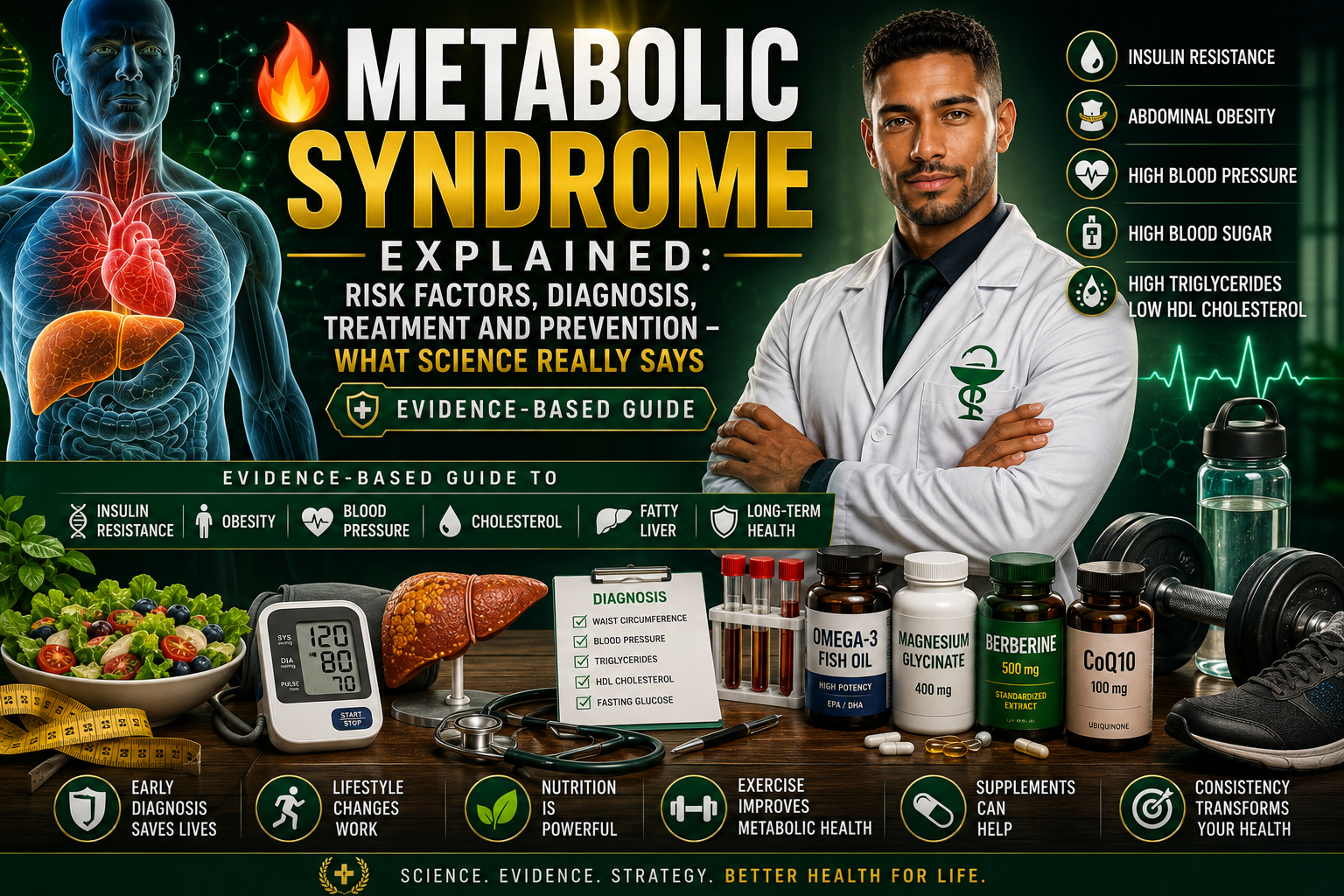

Evidence-Based Guide to Insulin Resistance, Obesity, Blood Pressure, Cholesterol, Fatty Liver and Long-Term Health
Author: Matheus Lucas Araújo Sousa, Pharmacist
Part 1 – Understanding Metabolic Syndrome
🌍 Introduction
Metabolic Syndrome is one of the leading public health challenges worldwide. Rather than a single disease, it is a cluster of interconnected metabolic abnormalities that substantially increases the risk of cardiovascular disease, type 2 diabetes, chronic kidney disease, fatty liver (MASLD), and premature mortality.
Modern lifestyles—characterized by physical inactivity, excessive calorie intake, poor sleep, and chronic stress—have contributed to its growing prevalence across all age groups.
The encouraging news is that Metabolic Syndrome is often preventable and, in many individuals, partially or fully reversible through evidence-based lifestyle interventions.
In this article, you’ll learn:
- ❤️ What Metabolic Syndrome is
- 🧬 Why it develops
- 📋 Diagnostic criteria
- 🩺 Recommended medical follow-up
- 🏋️ The role of exercise
- 🥗 Nutrition strategies
- 💊 Evidence-based supplements
- 📚 Current scientific recommendations
🩺 What Is Metabolic Syndrome?
Metabolic Syndrome is diagnosed when three or more specific cardiometabolic risk factors are present simultaneously.
These abnormalities reflect underlying metabolic dysfunction, particularly insulin resistance, which contributes to chronic inflammation and vascular damage.
Instead of viewing high blood pressure, abdominal obesity, and abnormal cholesterol as isolated conditions, Metabolic Syndrome recognizes that these factors interact and amplify long-term health risks.
⚙️ How Does Metabolic Syndrome Develop?
The process typically begins with insulin resistance.
Simplified progression
Unhealthy Diet + Physical Inactivity + Poor Sleep + Chronic Stress

📋 Diagnostic Criteria
According to widely used international criteria, Metabolic Syndrome is diagnosed when three or more of the following are present:

🚨 Major Risk Factors
Several factors increase the likelihood of developing Metabolic Syndrome.
Lifestyle
- 🍔 Ultra-processed diet
- 🥤 Sugar-sweetened beverages
- 🛋 Sedentary lifestyle
- 🚬 Smoking
- 🍺 Excessive alcohol intake
- 😴 Poor sleep quality
- 😰 Chronic stress
Medical Conditions
- Obesity
- Prediabetes
- Type 2 Diabetes
- MASLD
- Polycystic Ovary Syndrome (PCOS)
- Hypertension
- Dyslipidemia
Non-Modifiable Factors
- Increasing age
- Family history
- Certain genetic predispositions
⚠️ Why Is Metabolic Syndrome Dangerous?
Without appropriate management, Metabolic Syndrome increases the risk of:
- ❤️ Heart attack
- 🧠 Stroke
- 🩸 Type 2 Diabetes
- 🫀 Fatty Liver Disease (MASLD)
- 🩺 Chronic Kidney Disease
- 👁 Retinal disease
- 🧬 Cognitive decline
- ⚡ Erectile Dysfunction
- ☠️ Premature mortality
🔬 The Central Role of Insulin Resistance
Insulin normally helps move glucose from the bloodstream into cells.
When cells become less responsive to insulin:
- Blood glucose rises.
- The pancreas produces more insulin.
- Excess insulin promotes fat storage.
- The liver produces more triglycerides.
- Blood pressure tends to increase.
- Chronic inflammation develops.
This creates a vicious cycle that drives the progression of Metabolic Syndrome.
🫀 Why Waist Circumference Matters
Visceral fat is metabolically active and contributes to:
- Increased inflammatory cytokines
- Hormonal imbalance
- Insulin resistance
- Liver fat accumulation
- Cardiovascular disease risk
Reducing abdominal fat is therefore one of the most effective strategies for improving metabolic health.
🧬 Relationship with Fatty Liver (MASLD)
Metabolic Syndrome and MASLD frequently coexist.
People with Metabolic Syndrome have a significantly higher likelihood of developing liver fat accumulation, while individuals with MASLD often meet the diagnostic criteria for Metabolic Syndrome.
For this reason, healthcare professionals commonly evaluate both conditions together.
✅ Key Takeaways (Part 1)
✔ Metabolic Syndrome is a cluster of interconnected metabolic risk factors.
✔ Insulin resistance is a major underlying mechanism.
✔ Visceral obesity plays a central role.
✔ Early diagnosis allows timely intervention before serious complications develop.
✔ Lifestyle changes remain the cornerstone of prevention and treatment.
Part 2 – Diagnosis and Clinical Follow-Up
🩺 Diagnosing Metabolic Syndrome
Metabolic Syndrome cannot be diagnosed using a single laboratory test. Instead, healthcare professionals evaluate a combination of clinical measurements, laboratory findings, and individual cardiovascular risk factors.
Early diagnosis is crucial because many people remain asymptomatic for years while metabolic damage gradually progresses.
📏 Step 1 – Measuring Waist Circumference
Waist circumference is one of the simplest and most informative markers of visceral obesity, which is strongly associated with insulin resistance.
How to Measure Correctly
✔ Stand upright
✔ Relax your abdomen
✔ Place the measuring tape midway between the lowest rib and the top of the hip bone
✔ Measure after a normal exhalation
Why It Matters
Unlike subcutaneous fat, visceral fat surrounds internal organs and actively releases inflammatory molecules that contribute to:
- 🔥 Chronic inflammation
- 🍬 Insulin resistance
- 🫀 Fatty liver (MASLD)
- ❤️ Cardiovascular disease
🩸 Step 2 – Blood Pressure Assessment
Blood pressure should be measured using validated equipment after:
- Sitting quietly for at least 5 minutes
- Avoiding caffeine, smoking and exercise for approximately 30 minutes beforehand
- Using the correct cuff size
Diagnostic Threshold
≥130/85 mmHg
or
Current antihypertensive treatment.
Persistent elevations require evaluation by a healthcare professional, as diagnosis should not rely on a single measurement.
🍬 Step 3 – Blood Glucose Evaluation
Abnormal glucose metabolism is one of the earliest features of Metabolic Syndrome.
Common Laboratory Tests

Persistent abnormalities may indicate prediabetes or diabetes and warrant further evaluation.
❤️ Step 4 – Lipid Profile
A complete lipid profile provides important information about cardiovascular risk.
Standard Tests
- ❤️ Total Cholesterol
- ❤️ LDL Cholesterol
- ❤️ HDL Cholesterol
- 🩸 Triglycerides
Typical findings in Metabolic Syndrome include:
⬆ Elevated triglycerides
⬇ Reduced HDL cholesterol
These changes increase the risk of atherosclerotic cardiovascular disease.
🫀 Step 5 – Liver Function Assessment
Because MASLD frequently accompanies Metabolic Syndrome, liver evaluation is often appropriate.
Common Laboratory Tests
- ALT
- AST
- GGT
- Alkaline phosphatase
- Bilirubin (when clinically indicated)
Abnormal liver enzymes may suggest liver injury but normal results do not exclude MASLD, especially in early stages.
🖥️ Step 6 – Imaging Studies
Imaging may be recommended depending on the clinical situation.
Common Methods
🟢 Abdominal Ultrasound
Often the first imaging test used to detect liver fat.
🟡 FibroScan® (Transient Elastography)
Assesses liver stiffness and helps estimate fibrosis.
🔵 MRI
Highly sensitive for quantifying liver fat but generally reserved for selected cases.
🔴 Liver Biopsy
Considered only when the diagnosis is uncertain or when staging liver disease will influence management.
📈 Cardiovascular Risk Assessment
Because cardiovascular disease is the leading cause of complications in Metabolic Syndrome, overall risk should be assessed.
Factors commonly considered include:
- Age
- Smoking status
- Blood pressure
- Diabetes
- Lipid profile
- Kidney function
- Family history of premature cardiovascular disease
Risk estimation tools can help guide preventive strategies but should always be interpreted alongside clinical judgment.
📅 Long-Term Clinical Follow-Up
Metabolic Syndrome requires ongoing monitoring rather than a single assessment.
A typical follow-up plan may include:

*The ideal interval varies according to each person’s health status, risk factors, treatment goals, and the recommendations of their healthcare professional.
🚨 Warning Signs That Require Medical Evaluation
Seek prompt medical assessment if you experience:
- Persistent blood pressure elevation
- Rapid increase in abdominal circumference
- Unexplained fatigue
- Markedly elevated blood glucose
- Chest pain
- Shortness of breath
- Symptoms suggestive of stroke (such as sudden weakness, facial drooping, or speech difficulty)
- Yellowing of the skin or eyes (jaundice)
📊 Clinical Assessment Flow

✅ Key Takeaways (Part 2)
✔ Metabolic Syndrome is diagnosed by combining clinical findings and laboratory results—not by a single test.
✔ Waist circumference is a practical marker of visceral obesity and cardiometabolic risk.
✔ Blood pressure, blood glucose, lipids, and liver health should be evaluated together.
✔ Imaging studies may be useful in selected patients, particularly when MASLD is suspected.
✔ Regular follow-up allows earlier intervention and better long-term outcomes.
Part 3 – Evidence-Based Treatment, Prevention and Long-Term Follow-Up
🩺 Can Metabolic Syndrome Be Reversed?
Yes—in many people, Metabolic Syndrome can be significantly improved or even reversed through comprehensive lifestyle changes.
Scientific evidence consistently shows that the most effective treatment is not a single medication or supplement, but rather a combination of:
- 🥗 Healthy nutrition
- 🏋️ Regular resistance training
- 🚶 Aerobic exercise
- 😴 Quality sleep
- ⚖️ Sustainable weight loss (when indicated)
- 🚭 Smoking cessation
- 🍺 Limiting alcohol intake
- 😌 Stress management
These interventions improve insulin sensitivity, reduce visceral fat, lower blood pressure, improve lipid levels, and decrease the risk of cardiovascular disease.
🥗 Nutrition: The Foundation of Treatment
No single “superfood” cures Metabolic Syndrome.
Instead, research consistently supports dietary patterns rich in minimally processed foods.
Foods to Prioritize
🥬 Vegetables
🥦 Cruciferous vegetables
🍓 Fruits
🫘 Legumes
🌾 Whole grains
🥜 Nuts and seeds
🐟 Fatty fish
🫒 Extra virgin olive oil
🥚 Lean protein sources
💧 Water
Foods to Limit
🍟 Ultra-processed foods
🥤 Sugar-sweetened beverages
🍰 Refined sugars
🍞 Refined carbohydrates
🍕 Fast food
🥓 Processed meats
🍺 Excess alcohol
🏋️ Exercise: Powerful Medicine
Exercise improves nearly every component of Metabolic Syndrome.
Benefits include:
✔ Better insulin sensitivity
✔ Lower blood pressure
✔ Reduced triglycerides
✔ Higher HDL cholesterol
✔ Less visceral fat
✔ Improved liver health
✔ Better mental health
✔ Increased muscle mass
Recommended Weekly Exercise Targets
International guidelines generally recommend:
✅ 150–300 minutes/week of moderate aerobic activity (or 75–150 minutes/week of vigorous activity)
PLUS
✅ Resistance training at least 2–3 times per week, targeting the major muscle groups.
Even modest increases in physical activity can produce meaningful metabolic improvements.
⚖️ Why Weight Loss Matters
Losing excess body weight—especially visceral fat—can improve multiple components of Metabolic Syndrome.
Evidence suggests that gradual weight reduction may:
- Improve insulin sensitivity
- Reduce liver fat
- Lower blood pressure
- Improve cholesterol and triglycerides
- Reduce inflammation
- Decrease the risk of type 2 diabetes and cardiovascular disease
The emphasis should be on sustainable habits rather than rapid weight loss.
💊 Evidence-Based Supplements
Supplements may complement lifestyle changes but should not replace healthy eating, exercise, or medical care.
🥇 Strongest Evidence

🥈 Moderate Evidence

🥉 Emerging Evidence
Research is ongoing regarding:
- 🦠 Probiotics
- 🌿 Curcumin
- 🍇 Resveratrol
These supplements may be promising in selected situations, but more high-quality clinical trials are needed before they can be routinely recommended.
😴 Sleep and Stress: Often Overlooked
Chronic sleep deprivation and persistent stress increase cortisol levels, worsen insulin resistance, and make weight management more difficult.
Aim for:
🌙 7–9 hours of quality sleep
🧘 Stress management through relaxation techniques, regular physical activity, mindfulness, social support, or psychological care when needed.
🚭 Lifestyle Habits That Make a Difference
Small, consistent actions often have the greatest long-term impact.
Daily Checklist
✅ Eat mostly minimally processed foods
✅ Exercise regularly
✅ Build and preserve muscle mass
✅ Walk more throughout the day
✅ Maintain a healthy waist circumference
✅ Sleep well
✅ Avoid smoking
✅ Limit alcohol
✅ Keep regular medical appointments
📈 Long-Term Monitoring
Regular follow-up helps track progress and adjust treatment when necessary.
Recommended monitoring may include:
- ⚖️ Body weight
- 📏 Waist circumference
- ❤️ Blood pressure
- 🍬 Fasting glucose
- 🩸 HbA1c
- 🧪 Lipid profile
- 🫀 Liver enzymes
- 🧬 Kidney function (when indicated)
Follow-up intervals should always be individualized according to clinical status and healthcare guidance.
✅ Key Takeaways
✔ Metabolic Syndrome is highly prevalent but often preventable and manageable.
✔ Insulin resistance is a central mechanism linking its different components.
✔ Nutrition and regular exercise remain the cornerstone of treatment.
✔ Even modest improvements in body weight and physical activity can produce meaningful health benefits.
✔ Some supplements may provide additional support when used appropriately, but none replace lifestyle modification.
✔ Early diagnosis and consistent follow-up reduce the risk of cardiovascular disease, type 2 diabetes, and fatty liver progression.
👨⚕️ About the Author
Matheus Lucas Araújo Sousa
Pharmacist | Evidence-Based Health Writer
Matheus Lucas Araújo Sousa is a pharmacist dedicated to translating high-quality scientific evidence into practical, easy-to-understand health information. His work focuses on preventive medicine, nutrition, supplementation, metabolic health, healthy aging, and empowering readers to make informed decisions through evidence-based education.
🔗 Related Evidence-Based Articles
If you enjoyed this article, you may also like:
- 🫀 Fatty Liver (MASLD): Can Exercise and Supplements Reverse Liver Fat? What Science Really Says
- 🔥 Insulin Resistance: Early Signs, Diagnosis and Natural Ways to Improve Metabolic Health
- 🐟 Omega-3 Benefits: What Science Really Says About Heart, Brain and Longevity
- 🌱 Berberine: Benefits, Uses and What Science Really Says
- ⚡ Coenzyme Q10 (CoQ10): Benefits, Uses, Dosage and What Science Really Says
- 💪 Creatine: Benefits, Safety, Dosage and How It Works
- ☀️ Vitamin D Deficiency: Symptoms, Causes, Treatment and Prevention
- 🧬 The Science of Healthy Aging: Evidence-Based Strategies to Slow Aging Naturally
- 🔥 Oxidative Stress: When Free Radicals Outnumber Antioxidants
📖 Selected Scientific References
- Alberti KGMM, Eckel RH, Grundy SM, et al. Harmonizing the Metabolic Syndrome: A Joint Interim Statement of International Societies. Circulation.
- American Diabetes Association (ADA). Standards of Care in Diabetes.
- European Society of Cardiology (ESC). Guidelines on Cardiovascular Disease Prevention.
- European Association for the Study of the Liver (EASL). Clinical Practice Guidelines on MASLD.
- Grundy SM. Metabolic Syndrome Update. Trends in Cardiovascular Medicine.
- World Health Organization (WHO). Obesity and Cardiometabolic Health.
- American Heart Association (AHA). Guideline for the Primary Prevention of Cardiovascular Disease.
Conclusion
Metabolic Syndrome is one of the most important and preventable health challenges of our time. Although it markedly increases the risk of heart disease, type 2 diabetes, fatty liver disease, and other chronic conditions, its progression is not inevitable. Scientific evidence consistently demonstrates that early diagnosis, healthy nutrition, regular physical activity, adequate sleep, and long-term follow-up can substantially improve metabolic health and reduce future complications. Building sustainable habits today is one of the most effective investments for protecting long-term health and quality of life.
Leave a Reply