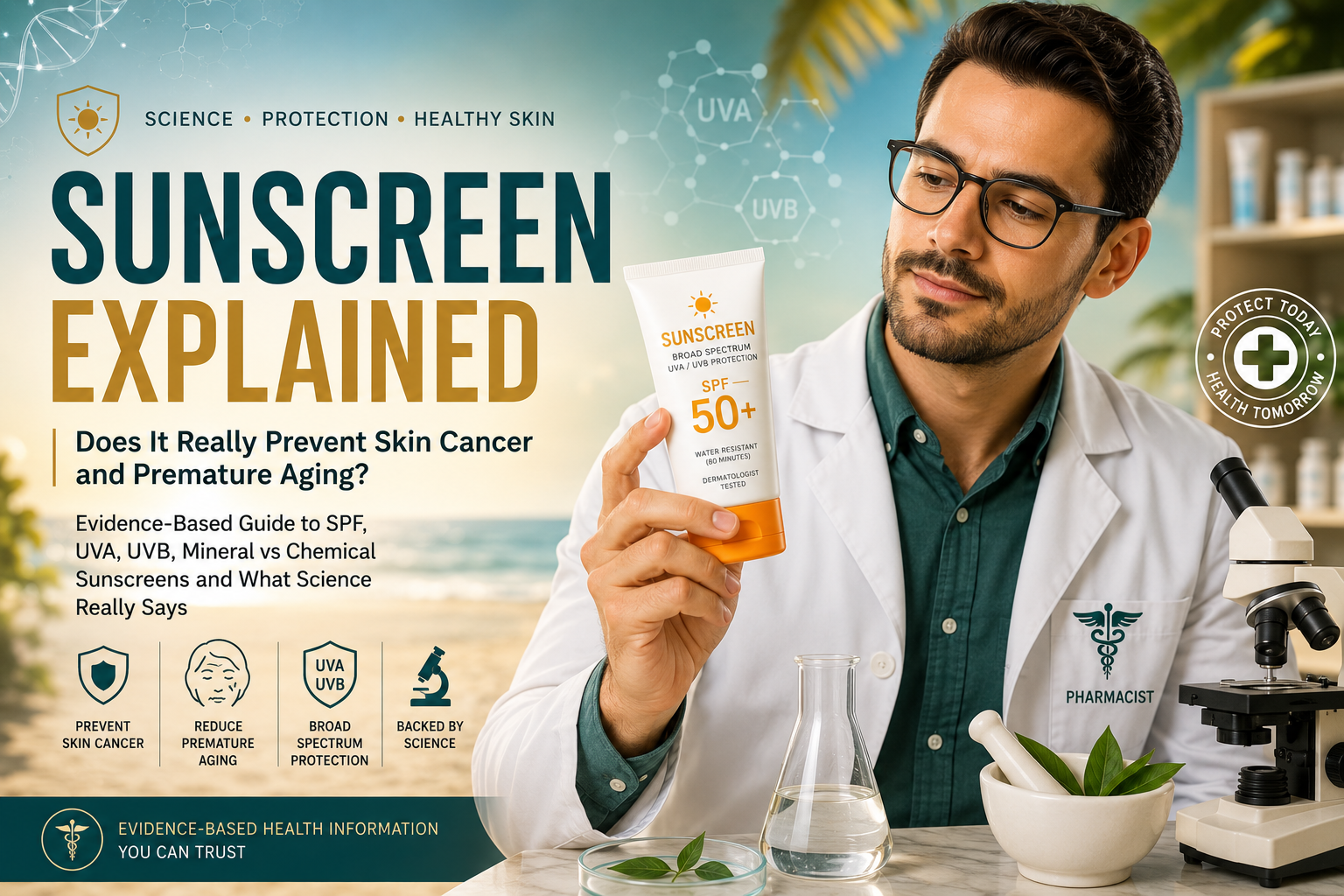

Evidence-Based Guide to SPF, UVA, UVB, Mineral vs Chemical Sunscreens and What Science Really Says
🌿 Introduction
Sunscreen is one of the most widely recommended skincare products by dermatologists worldwide. Every year, millions of people use it to protect against sunburn, reduce premature skin aging, and lower the risk of skin cancer.
Despite its popularity, sunscreen remains surrounded by misconceptions. Some believe it completely blocks vitamin D production, while others assume that a higher SPF allows unlimited sun exposure or that sunscreen is only necessary on sunny summer days.
What does science actually say?
Current evidence consistently shows that regular and correct sunscreen use is one of the most effective strategies for preventing ultraviolet (UV) radiation damage, reducing the risk of several forms of skin cancer, and slowing visible signs of skin aging.
However, sunscreen is not a complete shield. Its effectiveness depends on choosing the appropriate product, applying enough of it, reapplying at the right intervals, and combining it with other sun-protection strategies.
This evidence-based guide explains how sunscreen works, what SPF really means, the differences between UVA and UVB radiation, mineral versus chemical sunscreens, common myths, and practical recommendations supported by current scientific research.
☀️ Why Does the Sun Damage Our Skin?

Sunlight is essential for life and plays an important role in vitamin D synthesis and circadian rhythm regulation. However, excessive exposure to ultraviolet radiation can damage skin cells at the molecular level.
Ultraviolet radiation penetrates the skin and generates oxidative stress, producing unstable molecules known as free radicals. These molecules can injure cell membranes, proteins, collagen fibers, elastin, and DNA.
Over time, repeated UV exposure contributes to:
- 👴 Premature skin aging (photoaging)
- 🧬 DNA mutations
- 🌑 Hyperpigmentation and age spots
- 🧴 Loss of collagen and skin elasticity
- 🔥 Sunburn
- ⚠️ Increased risk of skin cancer
This cumulative damage occurs gradually and often begins years before visible signs appear.
🌞 Understanding UV Radiation
Sunlight contains different types of ultraviolet radiation, but UVA and UVB are the most important for skin health.
🟣 UVA Rays
UVA rays account for approximately 95% of the ultraviolet radiation reaching the Earth’s surface.
Characteristics:
- Penetrate deeply into the skin
- Reach the dermis
- Accelerate collagen breakdown
- Promote wrinkle formation
- Increase oxidative stress
- Contribute to skin cancer development
Unlike UVB, UVA intensity remains relatively constant throughout the year and can penetrate clouds and ordinary window glass.
🔴 UVB Rays
UVB rays primarily affect the outer layers of the skin.
They are responsible for:
- Sunburn
- Direct DNA damage
- Most vitamin D production
- Increased skin cancer risk
UVB intensity is greatest around midday and during summer months.
🧬 UVA vs UVB: What’s the Difference?

Both types contribute to skin cancer, making broad-spectrum sunscreen essential.
🛡️ What Does SPF Really Mean?
SPF stands for Sun Protection Factor.
It measures how effectively a sunscreen protects the skin against UVB radiation, the primary cause of sunburn.
Contrary to popular belief, SPF is not a measure of how many hours you can safely stay in the sun.
Instead, it reflects the level of UVB protection under standardized testing conditions.
Approximate UVB protection:
- SPF 15 → about 93%
- SPF 30 → about 97%
- SPF 50 → about 98%
- SPF 100 → about 99%
The increase in protection becomes progressively smaller at very high SPF values, reinforcing that proper application and regular reapplication are more important than choosing the highest SPF available.
❓ Does Sunscreen Prevent Skin Cancer?
This is one of the most important questions in preventive dermatology.
The answer is yes—when used correctly as part of a comprehensive sun-protection strategy.
Large observational studies and randomized clinical trials have shown that regular sunscreen use reduces the incidence of several skin cancers, particularly squamous cell carcinoma, and contributes to lowering the risk of melanoma, the deadliest form of skin cancer.
Protection is greatest when sunscreen is combined with:
- 👒 Wide-brimmed hats
- 👕 Protective clothing
- 🕶️ UV-blocking sunglasses
- 🌳 Seeking shade during peak UV hours
- ⏰ Avoiding excessive midday sun exposure
Sunscreen should be viewed as one component of a complete sun-safety strategy rather than permission for prolonged sun exposure.
Part 2 – How Sunscreen Protects Your Skin and Choosing the Right Product
👵 Can Sunscreen Really Slow Skin Aging?
One of the greatest misconceptions about sunscreen is that its only purpose is to prevent sunburn.
In reality, one of its most important long-term benefits is reducing premature skin aging, also known as photoaging.
Photoaging refers to skin changes caused by years of cumulative ultraviolet (UV) exposure rather than natural aging alone.
Scientific studies estimate that up to 80% of visible facial aging is related to chronic sun exposure, making UV radiation one of the most important preventable causes of wrinkles and loss of skin quality.
🧬 How UV Radiation Accelerates Aging
Every time ultraviolet rays reach the skin, they trigger a cascade of biological events.
UV exposure increases the production of free radicals, highly reactive molecules that damage healthy cells.
This process contributes to:
- 🧴 Collagen breakdown
- 🧬 DNA damage
- 🦴 Elastin degradation
- 🔥 Chronic inflammation
- 🌑 Hyperpigmentation
- 👴 Wrinkles and fine lines
Over many years, these microscopic injuries accumulate and become visible as:
✔ Sagging skin
✔ Rough texture
✔ Uneven pigmentation
✔ Reduced elasticity
✔ Deep wrinkles
Daily sunscreen helps interrupt this cycle by reducing UV-induced cellular damage.
🛡️ How Sunscreen Protects Collagen
Collagen provides firmness and structural support to the skin.
Ultraviolet radiation activates enzymes called matrix metalloproteinases (MMPs).
These enzymes break down collagen fibers faster than the body can replace them.
Broad-spectrum sunscreen reduces this enzymatic activation, helping preserve collagen and maintain healthier skin over time.
Although sunscreen cannot completely stop aging, consistent use significantly slows UV-related collagen loss.
🌞 Mineral vs Chemical Sunscreens
Modern sunscreens generally fall into two categories.
🪨 Mineral (Physical) Sunscreens
Active ingredients commonly include:
- Zinc Oxide
- Titanium Dioxide
These ingredients primarily protect by interacting with UV radiation at the skin surface.
Advantages
✔ Broad-spectrum protection
✔ Effective immediately after application
✔ Less irritating for sensitive skin
✔ Often recommended for children and individuals with rosacea
Limitations
- May leave a white cast
- Thicker texture
- Can be more visible on darker skin tones
🧪 Chemical Sunscreens
Chemical sunscreens use organic UV filters that absorb ultraviolet energy before it can damage the skin.
Common filters include:
- Avobenzone
- Octocrylene
- Octisalate
- Homosalate
- Bemotrizinol (where approved)
Advantages
✔ Lightweight texture
✔ Transparent finish
✔ Easier daily wear
✔ Better cosmetic elegance
Limitations
- May irritate sensitive skin in some individuals
- Usually require application about 15 minutes before sun exposure
- Formulations vary by country due to different regulatory approvals
⚖️ Which Type Is Better?
Scientific evidence indicates that both mineral and chemical sunscreens are highly effective when applied correctly.
The “best” sunscreen is the one that you are willing to use consistently every day.
Choice depends on:
- Skin sensitivity
- Cosmetic preference
- Outdoor activity
- Water exposure
- Individual tolerance
🎯 How Much Sunscreen Should You Apply?
One of the biggest reasons sunscreen fails is underapplication.
Most people use only 25–50% of the amount tested in clinical studies.
General recommendations include:
Face and Neck
Approximately:
🧴 Two finger lengths of sunscreen
or
🥄 About 1/3 teaspoon
Entire Body
Approximately:
🥃 One shot-glass amount (about 30 mL)
for a fully exposed adult body.
⏰ When Should You Reapply?
Even water-resistant sunscreens gradually lose effectiveness.
Experts recommend reapplying:
✔ Every two hours during continuous outdoor exposure
✔ Immediately after swimming
✔ After excessive sweating
✔ After towel drying
Morning application alone is usually insufficient for prolonged outdoor activities.
💧 What Does “Water Resistant” Mean?
Water-resistant products continue providing protection for a limited time while swimming or sweating.
Common labels include:
- 40 minutes
- 80 minutes
No sunscreen is completely waterproof.
Reapplication remains essential.
☁️ Do You Need Sunscreen on Cloudy Days?
Yes.
Up to 80% of ultraviolet radiation can penetrate cloud cover.
This explains why many people experience sunburn despite overcast weather.
UVA radiation also penetrates windows, meaning significant exposure can occur while:
- Driving
- Sitting near large windows
- Working indoors with prolonged sunlight exposure
🧴 Should You Wear Sunscreen Indoors?
For most people who spend the day away from windows, routine indoor sunscreen use may not be necessary.
However, daily sunscreen is advisable if you:
- Work beside windows
- Drive for extended periods
- Spend time on balconies or patios
- Use prescription retinoids or exfoliating acids
- Have a history of skin cancer or photosensitive skin conditions
🌞 Does Sunscreen Prevent Vitamin D Production?
This is one of the most common myths.
Although sunscreen can reduce UVB exposure under laboratory conditions, real-world studies have shown that regular sunscreen use does not usually cause clinically significant vitamin D deficiency.
Small amounts of incidental sun exposure during daily life are often enough for vitamin D production in many individuals.
When deficiency is present, healthcare professionals may recommend dietary changes or supplementation rather than reducing sun protection.
📊 Choosing the Right Sunscreen

🧠 Key Takeaways
Scientific evidence strongly supports daily sunscreen use as one of the most effective strategies for protecting long-term skin health.
Consistent use can help:
- ☀️ Prevent sunburn
- 👴 Slow premature skin aging
- 🧬 Reduce cumulative DNA damage
- 🛡️ Lower the risk of several skin cancers
- 💪 Preserve collagen and skin elasticity
However, sunscreen works best when combined with protective clothing, shade, sunglasses, and sensible sun exposure habits.
Part 3 – Common Myths, Daily Sun Protection Routine and What Science Really Says
❌ Common Sunscreen Myths
Despite decades of scientific research, sunscreen remains surrounded by misinformation. Understanding the facts helps people make better decisions for long-term skin health.
❌ Myth 1: “I only need sunscreen on sunny days.”
✅ Science
Ultraviolet radiation reaches the Earth’s surface even when it is cloudy.
Research suggests that up to 80% of UV radiation can penetrate cloud cover, meaning skin damage can occur even when the sun is not visible.
Daily protection is recommended regardless of weather conditions.
❌ Myth 2: “People with dark skin don’t need sunscreen.”
✅ Science
Melanin provides some natural protection against ultraviolet radiation, but it does not eliminate the risk of sun damage.
Individuals with darker skin can still develop:
- Skin cancer
- Hyperpigmentation
- Melasma
- Premature aging
- DNA damage
Everyone benefits from daily sun protection.
❌ Myth 3: “A higher SPF lets me stay in the sun all day.”
✅ Science
No sunscreen blocks 100% of ultraviolet radiation.
Even SPF 100 allows a small amount of UV exposure.
Reapplication every two hours remains essential during prolonged outdoor activities.
❌ Myth 4: “One application lasts the entire day.”
✅ Science
Sweating, swimming, friction from clothing, and natural skin oils gradually reduce sunscreen effectiveness.
Regular reapplication is necessary to maintain protection.
❌ Myth 5: “Sunscreen contains dangerous chemicals.”
✅ Science
Modern sunscreen ingredients approved by major regulatory agencies undergo extensive safety evaluation.
Organizations worldwide continue to conclude that the benefits of sunscreen in preventing UV damage and skin cancer greatly outweigh potential risks when products are used as directed.
🔬 Ingredients to Look For
Different active ingredients provide protection through different mechanisms.
🪨 Mineral Filters
✔ Zinc Oxide
✔ Titanium Dioxide
Benefits:
- Broad-spectrum protection
- Suitable for sensitive skin
- Immediate protection after application
🧪 Chemical Filters
Examples include:
- Avobenzone
- Octocrylene
- Octisalate
- Homosalate
- Bemotrizinol (where available)
Benefits:
- Lightweight texture
- Excellent cosmetic appearance
- Comfortable for daily use
🧴 Daily Sunscreen Routine
Dermatologists recommend incorporating sunscreen into the morning skincare routine.
A practical sequence is:
- 🧼 Cleanser
- 💧 Serum (optional)
- 🧴 Moisturizer
- ☀️ Broad-spectrum sunscreen
- 💄 Makeup (if used)
During prolonged outdoor exposure:
✔ Reapply every two hours.
✔ Reapply immediately after swimming or heavy sweating.
🌎 Additional Sun Protection Strategies
Sunscreen works best when combined with other protective measures.
Experts recommend:
👒 Wide-brimmed hats
🕶️ UV-blocking sunglasses
👕 UPF-rated clothing
🌳 Seeking shade whenever possible
⏰ Limiting direct sun exposure between approximately 10 AM and 4 PM, when UV radiation is generally strongest.
👶 Sunscreen for Children
Infants younger than 6 months should generally avoid direct sun exposure whenever possible.
For older infants and children:
✔ Use broad-spectrum sunscreen.
✔ Apply generously.
✔ Reapply regularly.
✔ Combine sunscreen with protective clothing and shade.
These measures provide the most effective protection for developing skin.
🌍 Environmental Considerations
Growing attention has been given to the environmental impact of some sunscreen ingredients.
Some regions recommend or regulate products intended for sensitive marine ecosystems.
Consumers visiting coral reef areas may consider products labeled as environmentally responsible where appropriate.
Regardless of formulation, protecting human health remains the primary priority.
📋 Evidence-Based Sun Protection Checklist
✅ Apply sunscreen every morning.
✅ Choose broad-spectrum protection.
✅ Prefer SPF 30 or higher for everyday use.
✅ Use approximately two finger lengths for the face and neck.
✅ Reapply every two hours outdoors.
✅ Wear sunglasses with UV protection.
✅ Wear protective clothing whenever possible.
✅ Seek shade during peak UV hours.
✅ Avoid intentional tanning.
✅ Monitor your skin regularly for new or changing moles and consult a healthcare professional if abnormalities appear.
⭐ Final Thoughts
Ultraviolet radiation is one of the most significant environmental factors affecting skin health throughout life.
Scientific evidence consistently demonstrates that daily sunscreen use is among the most effective preventive measures available for reducing cumulative UV damage.
Regular sunscreen application helps:
- ☀️ Prevent sunburn
- 🧬 Reduce DNA damage
- 👴 Slow premature skin aging
- 🧴 Preserve collagen and skin elasticity
- ⚠️ Lower the risk of several forms of skin cancer
However, sunscreen is not a substitute for healthy sun habits. The greatest protection comes from combining sunscreen with protective clothing, sunglasses, shade, and sensible sun exposure.
Choosing a sunscreen that you enjoy using—and applying it correctly every day—is one of the simplest and most effective investments you can make for your long-term skin health.
📚 Scientific References
- American Academy of Dermatology. Recommendations for sunscreen use and skin cancer prevention.
- World Health Organization. Ultraviolet radiation and public health.
- Centers for Disease Control and Prevention. Sun Safety Guidelines.
- Skin Cancer Foundation. Evidence-based recommendations for sun protection.
- National Cancer Institute. Skin cancer prevention resources.
- Peer-reviewed studies published in Journal of the American Academy of Dermatology, British Journal of Dermatology, JAMA Dermatology, Photodermatology, Photoimmunology & Photomedicine, and The Lancet.
👨⚕️ About the Author
Matheus Lucas Araújo Sousa, PharmD
Matheus Lucas Araújo Sousa is a Brazilian pharmacist committed to translating complex scientific evidence into practical, trustworthy health information. Through Strategic Health, he publishes evidence-based articles on nutrition, supplementation, preventive medicine, dermatology, healthy aging, metabolic health, and lifestyle interventions to help readers make informed decisions and improve long-term well-being.
🔗 Related Evidence-Based Articles
If you enjoyed this article, you may also like:
- 🧬 Collagen Supplements: Do They Really Work for Skin, Hair and Joints?
- 💇 Hair Loss Explained: Causes, Best Supplements and What Science Really Says
- 🧬 The Science of Healthy Aging: Evidence-Based Strategies to Slow Aging Naturally
- 🧠 Brain Health and Cognitive Longevity
- 🐟 Omega-3 Benefits: What Science Really Says About Heart, Brain and Longevity
- 🧴 Melatonin: Benefits, Dosage, Safety and What Science Really Says
- 🌱 Berberine: Benefits, Uses, Safety, Dosage and What Science Really Says
🌿 Thank You for Reading
Thank you for visiting Strategic Health.
Every article published on our website is carefully researched using high-quality scientific evidence to provide accurate, practical, and trustworthy health information.
Our mission is to help readers make informed decisions through evidence-based nutrition, preventive medicine, healthy aging strategies, and lifestyle interventions.
Stay curious. Stay informed. Stay healthy. 🌿
Leave a Reply