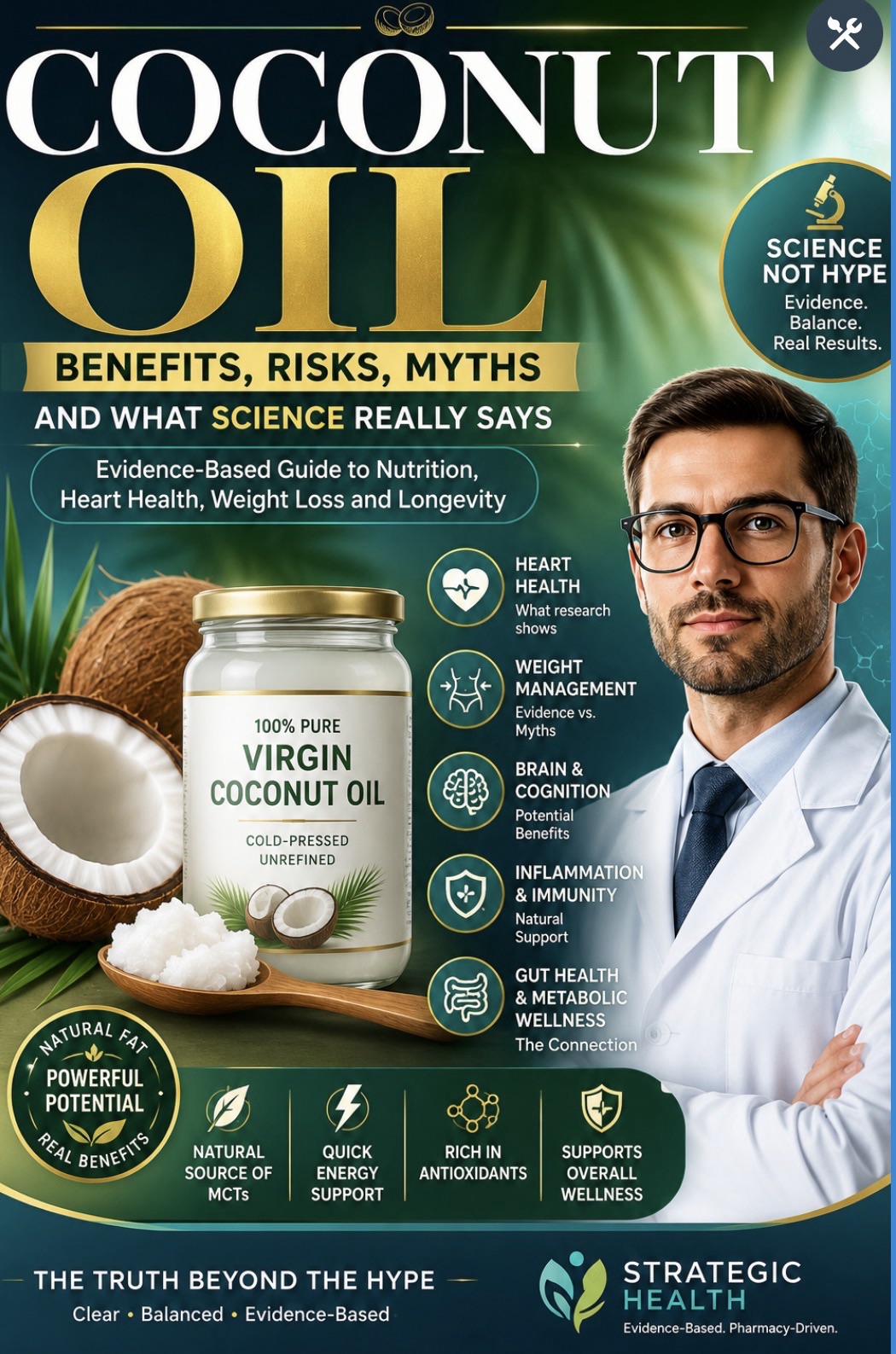
Evidence-Based Guide to Nutrition, Heart Health, Weight Loss and Longevity
Part 1 – Understanding Coconut Oil

🥥 Hero Section
Can coconut oil really improve your health, or is it simply one of the biggest nutrition myths of the last decade?
Coconut oil has become one of the world’s most debated dietary fats. Praised by some as a natural superfood and criticized by others because of its high saturated fat content, it continues to generate confusion among consumers and healthcare professionals alike.
Scientific evidence shows that the answer is far more nuanced than the headlines suggest. While coconut oil contains unique fatty acids that may provide certain metabolic advantages, it is not a miracle food—and understanding both its benefits and limitations is essential for making informed dietary choices.
In this evidence-based guide, we’ll examine the latest research on coconut oil, separating facts from myths while exploring its potential effects on metabolism, cardiovascular health, inflammation, brain function, and healthy aging.
📖 Introduction
Few foods have experienced such dramatic shifts in public perception as coconut oil.
For decades, dietary guidelines recommended limiting coconut oil because it is rich in saturated fat. More recently, social media and wellness influencers promoted it as a cure-all for obesity, Alzheimer’s disease, diabetes, and even cardiovascular disease.
The reality lies somewhere between these extremes.
Modern nutrition science recognizes that not all saturated fats behave identically in the human body. Coconut oil contains unique fatty acids, particularly lauric acid, that differ from the long-chain saturated fats commonly found in animal products.
However, major health organizations continue to recommend moderation because excessive intake may increase LDL cholesterol in many individuals.
Understanding this balance requires examining both its chemical composition and the latest clinical evidence.
🥥 What Is Coconut Oil?
Coconut oil is a vegetable oil extracted from the white flesh (kernel) of mature coconuts (Cocos nucifera).
Unlike most plant oils, coconut oil is composed predominantly of saturated fatty acids, giving it unique physical and metabolic properties.
At room temperature below approximately 24°C (76°F), coconut oil is naturally solid, becoming liquid in warmer environments.
For centuries, it has been used throughout tropical regions for:
🥥 Cooking
💄 Skin care
🦷 Oral hygiene
🥗 Traditional medicine
🥥 Food preservation
Today, coconut oil is widely consumed worldwide as both a culinary ingredient and a dietary supplement.
🌴 Types of Coconut Oil
Not all coconut oils are the same. Manufacturing methods significantly influence flavor, aroma, and the retention of natural compounds.

🧪 Nutritional Composition
One tablespoon (approximately 14 g) of coconut oil provides:

Unlike many other vegetable oils, coconut oil contains virtually no carbohydrates or protein, functioning almost exclusively as a source of dietary fat.
🧬 Lauric Acid and Medium-Chain Triglycerides (MCTs)
One of coconut oil’s defining characteristics is its fatty acid profile.
The major fatty acids include:
- 🥥 Lauric acid (C12:0)
- 🧬 Myristic acid
- ⚡ Caprylic acid
- ⚡ Capric acid
- 🛡️ Palmitic acid
- 🌿 Oleic acid
Lauric acid represents nearly half of the total fat content and is responsible for many of coconut oil’s unique biological properties.
Although often grouped with medium-chain triglycerides (MCTs), lauric acid behaves somewhat differently from shorter-chain MCTs such as caprylic (C8) and capric (C10) acids. It is absorbed more slowly and shares characteristics with both medium- and long-chain fatty acids.
This distinction is important because many studies on “MCT oil” cannot be directly applied to standard coconut oil.
⚙️ How Coconut Oil Is Metabolized
After consumption, coconut oil undergoes digestion in the small intestine.
Simplified pathway:
🥥 Coconut Oil
⬇️
Digestive Enzymes
⬇️
Fatty Acids Released
⬇️
Intestinal Absorption
⬇️
Transport to the Liver
⬇️
Energy Production (ATP)
⬇️
Storage or Oxidation
Compared with many long-chain fats, some fatty acids in coconut oil are transported more rapidly to the liver, where they may be oxidized for energy. However, because a substantial portion of coconut oil consists of lauric acid, its metabolism is not identical to purified MCT oil.
🌿 Potential Health Benefits
Current research suggests several potential benefits of coconut oil, although the strength of evidence varies.
❤️ 1. May Increase HDL Cholesterol
Several clinical studies have found that coconut oil can increase HDL (“good”) cholesterol. The overall cardiovascular impact, however, depends on the balance between HDL, LDL, and other risk factors.
🔥 2. Rapid Energy Source
Some of its fatty acids are metabolized relatively quickly and may provide a readily available energy source, particularly during periods of increased energy demand.
🦠 3. Antimicrobial Properties
Lauric acid can be converted into monolaurin, a compound that has demonstrated antimicrobial activity against certain bacteria, viruses, and fungi in laboratory studies. These findings do not necessarily translate into proven clinical benefits for routine dietary use.
🧠 4. Potential Brain Energy Support
Because medium-chain fats can contribute to ketone production under certain conditions, researchers continue to investigate whether they may support brain energy metabolism. At present, evidence is not sufficient to recommend coconut oil as a treatment for cognitive disorders.
🛡️ 5. Natural Antioxidant Compounds
Virgin coconut oil contains polyphenols and other bioactive compounds that may contribute modestly to antioxidant activity, although its antioxidant capacity is lower than that of many fruits, vegetables, nuts, and extra-virgin olive oil.
📌 Key Takeaways
✅ Coconut oil is rich in saturated fat but has a distinctive fatty acid profile.
✅ Virgin coconut oil retains more natural bioactive compounds than refined varieties.
✅ Some components are metabolized differently from typical long-chain fats.
✅ Current evidence supports potential benefits in specific contexts but does not justify viewing coconut oil as a cure-all.
✅ Dietary recommendations should consider the entire eating pattern rather than focusing on a single food.
Evidence-Based Guide to Nutrition, Heart Health, Weight Loss and Longevity
Part 2 – Clinical Evidence: Benefits, Risks and Practical Applications
❤️ Coconut Oil and Heart Health
Heart health remains the most controversial topic surrounding coconut oil.
Although coconut oil has been promoted as a “heart-healthy” fat by many online sources, the scientific evidence presents a more balanced picture.
Unlike olive oil, which is predominantly rich in monounsaturated fats, coconut oil contains approximately 90% saturated fat, making it one of the richest natural dietary sources of saturated fatty acids.
For many years, dietary guidelines recommended limiting saturated fat because excessive intake is associated with elevated LDL cholesterol—a well-established cardiovascular risk factor.
However, researchers later discovered that not all saturated fatty acids behave identically.
Coconut oil contains large amounts of lauric acid (C12:0), which appears to influence blood lipids differently than the saturated fats found in butter or processed meats.
The result is more complex than previously believed.
🩸 LDL vs HDL — What Does Science Really Say?
One of the reasons coconut oil became popular is its ability to increase HDL cholesterol.
HDL is often referred to as the “good cholesterol” because it helps transport excess cholesterol from tissues back to the liver.
Several randomized clinical trials have shown that coconut oil may increase HDL levels compared with some other dietary fats.
However, there is an important limitation.
Most studies also demonstrate that coconut oil increases LDL cholesterol, although often to a lesser extent than butter.
Current evidence suggests:
✅ HDL generally increases.
⚠️ LDL frequently increases.
⚖️ The overall cardiovascular benefit remains uncertain.
For this reason, organizations such as the American Heart Association continue to recommend replacing saturated fats with predominantly unsaturated fats whenever possible.
⚖️ Coconut Oil and Weight Loss
Perhaps no claim has generated more attention than the idea that coconut oil promotes rapid weight loss.
The theory originated because coconut oil contains medium-chain fatty acids.
These fats are metabolized differently from many long-chain fats and may modestly increase energy expenditure.
However, standard coconut oil is not equivalent to purified MCT oil.
Its high lauric acid content means its metabolic effects differ from those observed with concentrated MCT supplements.
What does the evidence show?
Current research indicates:
✔ Small increases in satiety may occur.
✔ Energy expenditure may increase slightly.
✔ Significant weight loss has not been consistently demonstrated.
The most important factor for weight reduction remains maintaining an overall calorie balance combined with healthy dietary habits and regular physical activity.
🧠 Brain Health
Researchers continue investigating whether coconut oil may support brain function.
Some fatty acids can contribute to ketone production under certain dietary conditions.
Ketones serve as an alternative fuel for brain cells.
This has led scientists to explore their potential role in neurodegenerative diseases such as Alzheimer’s disease.
At present:
✔ Early research is promising.
✔ Evidence remains limited.
✔ Coconut oil cannot be recommended as a treatment for Alzheimer’s disease or other neurological disorders.
More large clinical trials are still needed.
🔥 Inflammation and Oxidative Stress
Chronic inflammation and oxidative stress contribute to aging and numerous chronic diseases.
Virgin coconut oil contains:
🌿 Polyphenols
🛡️ Phenolic antioxidants
🥥 Bioactive compounds
Laboratory studies suggest these substances may reduce oxidative damage.
However, human studies have produced mixed results.
Overall, current evidence suggests that coconut oil may contribute modestly to antioxidant defenses but should not replace a diet rich in fruits, vegetables, legumes, and extra-virgin olive oil.
🩺 Diabetes and Insulin Resistance
Can coconut oil improve blood sugar?
The answer is not directly.
Current evidence indicates:
✔ Coconut oil does not significantly lower blood glucose.
✔ It should not be considered a treatment for diabetes.
✔ Replacing refined carbohydrates with healthy fats may improve overall dietary quality.
Some experimental studies suggest possible improvements in insulin signaling, but clinical evidence in humans remains insufficient to recommend coconut oil specifically for insulin resistance.
For individuals with diabetes, dietary patterns such as the Mediterranean diet continue to have stronger scientific support.
🦠 Gut Microbiome
The gut microbiome has become one of the most active areas of nutrition research.
Some laboratory studies indicate that lauric acid possesses antimicrobial properties.
Researchers have investigated whether these properties influence gut microbial composition.
Current evidence suggests:
🧫 Possible modulation of certain bacteria.
🦠 Potential antimicrobial activity.
⚠️ Human evidence remains limited.
Overall, maintaining a diverse, fiber-rich diet remains far more important for gut health than adding coconut oil alone.
🍳 Cooking With Coconut Oil
Coconut oil has a relatively high smoke point, making it suitable for many cooking methods.
Recommended uses include:
🥘 Stir-frying
🍳 Pan cooking
🥥 Baking
🥗 Moderate-heat recipes
Virgin coconut oil contributes a distinct coconut flavor, while refined coconut oil has a milder taste.
Although it can be part of a balanced diet, experts generally recommend using a variety of healthy oils rather than relying exclusively on coconut oil.
📊 Comparison of Common Cooking Fats

📌 Key Takeaways
✅ Coconut oil can increase HDL cholesterol, but it may also raise LDL cholesterol.
✅ Current evidence does not support coconut oil as a miracle food for weight loss.
✅ Its effects on brain health remain under investigation.
✅ Virgin coconut oil contains beneficial bioactive compounds, but these should complement—not replace—a balanced dietary pattern.
✅ For most people, moderation and dietary variety remain the most evidence-based approach.
Part 3 – Practical Recommendations, Safety and Final Conclusions
🚫 Who Should Limit or Avoid Coconut Oil?
Although coconut oil can be part of a balanced diet, it is not the ideal fat for everyone.
Individuals who should be especially cautious include:
❤️ People with High LDL Cholesterol
Because coconut oil is rich in saturated fat, excessive consumption may increase LDL cholesterol in susceptible individuals.
Replacing some saturated fats with unsaturated fats (such as extra virgin olive oil) remains the strategy most consistently supported by cardiovascular research.
🫀 Individuals at High Cardiovascular Risk
People with:
- Coronary artery disease
- Previous heart attack
- Stroke
- Familial hypercholesterolemia
- High cardiovascular risk
should discuss dietary fat choices with their healthcare professional.
⚖️ Individuals Trying to Lose Weight
Although coconut oil has gained popularity in weight-loss diets, it is still energy-dense.
One tablespoon provides approximately 120 kcal.
Consuming large amounts without adjusting total calorie intake may contribute to weight gain.
👶 Children and Pregnant Women
Coconut oil is generally considered safe as part of a varied diet.
However, no evidence supports consuming large supplemental amounts during pregnancy or childhood for disease prevention.
🥄 How Much Coconut Oil Is Reasonable?
There is no universally recommended daily intake specifically for coconut oil.
Most nutrition experts suggest:
✅ Use coconut oil as one of several healthy cooking fats.
✅ Prioritize overall dietary quality.
✅ Avoid replacing healthier unsaturated fats entirely.
Practical Recommendation
🥄 1–2 tablespoons per day (15–30 mL) may fit within a balanced diet for many healthy adults, depending on individual calorie needs and the rest of the dietary pattern.
The emphasis should remain on moderation, not supplementation.
💡 Practical Tips for Everyday Use
✔ Prefer virgin coconut oil whenever possible.
✔ Store in a cool, dry place away from direct sunlight.
✔ Use for moderate-heat cooking.
✔ Combine with other healthy fats such as:
- 🫒 Extra virgin olive oil
- 🥑 Avocado
- 🥜 Nuts
- 🌰 Seeds
✔ Maintain a diet rich in:
🥦 Vegetables
🍓 Fruits
🫘 Legumes
🌾 Whole grains
🐟 Fatty fish
Healthy aging depends on the overall dietary pattern—not a single ingredient.
❓ Frequently Asked Questions (FAQ)
Is coconut oil healthier than butter?
Generally, yes in terms of its lipid profile, but extra virgin olive oil has stronger evidence for cardiovascular protection.
Can coconut oil lower cholesterol?
Not reliably.
It often increases HDL cholesterol but may also raise LDL cholesterol.
Is coconut oil good for diabetes?
Current evidence does not support coconut oil as a treatment for diabetes.
Healthy eating patterns remain far more important.
Can coconut oil help with weight loss?
Only modestly, if at all.
No high-quality evidence shows substantial weight loss from coconut oil alone.
Is virgin coconut oil better than refined coconut oil?
Yes.
Virgin coconut oil retains more naturally occurring polyphenols and bioactive compounds.
Can coconut oil improve brain health?
Research is ongoing.
Current evidence is insufficient to recommend coconut oil for preventing or treating cognitive decline.
🧬 Key Takeaways
✅ Coconut oil is a unique plant-based fat rich in saturated fatty acids.
✅ Virgin coconut oil contains beneficial natural compounds.
✅ It may increase HDL cholesterol but can also increase LDL cholesterol.
✅ Claims regarding rapid weight loss and disease prevention are often exaggerated.
✅ The strongest scientific evidence continues to support dietary patterns rich in fruits, vegetables, legumes, nuts, whole grains, and unsaturated fats.
✅ Variety, moderation, and overall lifestyle remain the foundations of long-term health.
🛒 Recommended Evidence-Based Products
Choosing high-quality products can help you apply the evidence discussed in this article. While no single product is a miracle solution, the following options may support a balanced diet and healthy lifestyle when used appropriately.
🥥 1. Organic Extra Virgin Coconut Oil
Cold-pressed, unrefined coconut oil preserves more of its naturally occurring compounds and is the preferred option for culinary use.
Best for:
- Cooking at moderate temperatures
- Baking
- Smoothies
- Individuals who prefer minimally processed oils
🔗 Amazon Affiliate Link:
🫒 2. Extra Virgin Olive Oil
Current evidence consistently supports extra virgin olive oil as one of the healthiest dietary fats for long-term cardiovascular health. It can be an excellent complement to coconut oil within a balanced eating pattern.
Best for:
- Heart-healthy diets
- Mediterranean diet
- Salads
- Everyday cooking
🔗 Amazon Affiliate Link:
🥥 3. MCT Oil
Medium-chain triglyceride (MCT) oil provides concentrated MCTs and may be useful for individuals following low-carbohydrate or ketogenic diets, or those seeking a convenient energy source.
Best for:
- Coffee
- Smoothies
- Ketogenic diets
- Pre-workout nutrition
🔗 Amazon Affiliate Link:
🥄 4. Glass Oil Dispenser Bottle
A dark glass dispenser helps protect cooking oils from excessive light exposure while allowing better portion control in everyday use.
Best for:
- Portion control
- Kitchen organization
- Preserving oil quality
🔗 Amazon Affiliate Link:
📖 5. Mediterranean Diet Cookbook
One of the most evidence-based dietary patterns for cardiovascular and metabolic health. A Mediterranean diet cookbook can help readers incorporate healthier fats into practical meals.
Best for:
- Healthy cooking
- Weight management
- Heart health
- Long-term lifestyle change
🔗 Amazon Affiliate Link:
💡 Buying Tips
✔️ Choose 100% extra virgin, cold-pressed, unrefined coconut oil whenever possible.
✔️ Prefer products packaged in glass containers rather than plastic.
✔️ Check for organic certification if this is important to you.
✔️ Avoid products containing artificial flavors, preservatives, or hydrogenated fats.
✔️ Remember that coconut oil should be consumed in moderation as part of an overall balanced dietary pattern.
🔬 Evidence-Based Note
Current scientific evidence suggests that coconut oil can be included as part of a healthy diet, but it should not be viewed as a superfood or cure-all. Replacing all unsaturated fats with coconut oil is not recommended by major cardiovascular organizations. A varied eating pattern rich in fruits, vegetables, whole grains, legumes, nuts, fish, and healthy unsaturated fats remains the approach with the strongest evidence for promoting long-term health.
Affiliate Disclosure: As an Amazon Associate, StrategicHealths may earn a commission from qualifying purchases at no additional cost to you. We only recommend products that align with current scientific evidence and may provide practical value to our readers.
👨⚕️ Pharmacist’s Final Thoughts
As healthcare professionals, pharmacists play an essential role in helping people distinguish evidence-based recommendations from popular health myths.
Coconut oil is neither a miracle food nor a harmful ingredient when consumed responsibly.
Like many foods, its health effects depend on the quantity consumed, the individual’s health status, and the overall dietary pattern.
Nutrition science consistently shows that no single food determines health outcomes. Instead, sustainable habits—including balanced nutrition, regular physical activity, adequate sleep, stress management, and avoidance of smoking—have the greatest impact on healthy aging and disease prevention.
Choosing foods based on scientific evidence rather than marketing claims empowers individuals to make informed decisions that support lifelong well-being.
📚 Scientific References
- American Heart Association. Dietary Fats and Cardiovascular Disease: A Presidential Advisory. Circulation. 2017.
- World Health Organization (WHO). Healthy Diet Fact Sheet. Updated guidance.
- Harvard T.H. Chan School of Public Health. The Nutrition Source – Coconut Oil.
- Eyres L, Eyres MF, Chisholm A, Brown RC. Coconut oil consumption and cardiovascular risk factors in humans. Nutrition Reviews. 2016.
- Neelakantan N, Seah JYH, van Dam RM. The effect of coconut oil consumption on cardiovascular risk factors. Circulation. 2020.
- U.S. Department of Agriculture (USDA). FoodData Central.
- European Food Safety Authority (EFSA). Scientific Opinions on Dietary Fats.
🔗 Suggested Internal Links
To strengthen topical authority and improve navigation, link this article to related content on your blog:
- 🧬 The Science of Healthy Aging: Evidence-Based Strategies to Slow Aging Naturally
- 🔥 Insulin Resistance: Early Signs, Diagnosis and Natural Ways to Improve Metabolic Health
- 🥑 Omega-3 Benefits: What Science Really Says About Heart, Brain and Longevity
- ❤️ Coenzyme Q10 (CoQ10): Benefits, Uses, Dosage and Safety
- 💊 Magnesium Benefits: What Science Really Says
- 🌙 Melatonin: Benefits, Dosage, Safety and What Science Really Says
- 🌿 Berberine: Benefits, Dosage, Safety and What Science Really Says
- 🦠 The Completet Guide to Gut Health
📢 Final Conclusion
Coconut oil remains one of the most debated foods in modern nutrition. While it offers unique properties and can be part of a healthy diet, current scientific evidence does not support the idea that it is a “superfood” capable of preventing chronic diseases or promoting significant weight loss on its own.
For most people, the healthiest strategy is not to eliminate coconut oil—or to overconsume it—but to include it in moderation within a diverse dietary pattern rich in minimally processed foods, regular physical activity, quality sleep, and other evidence-based lifestyle habits.
By focusing on the overall quality of your lifestyle rather than individual foods, you build a stronger foundation for cardiovascular health, metabolic wellness, and healthy aging over the long term.
👨⚕️ About the Author
Matheus Lucas Araújo Sousa, PharmD
Matheus Lucas Araújo Sousa is a licensed pharmacist passionate about translating complex scientific evidence into clear, practical, and trustworthy health information.
Through Strategic Health, his mission is to help readers make informed decisions about nutrition, evidence-based supplementation, metabolic health, disease prevention, and healthy aging.
His work focuses on analyzing the latest scientific literature and international clinical guidelines to provide reliable, unbiased, and easy-to-understand educational content for readers worldwide.
Areas of Interest
🧬 Healthy Aging & Longevity
💊 Evidence-Based Supplementation
❤️ Cardiovascular Health
🧠 Brain & Cognitive Health
🩺 Metabolic Health
🥗 Clinical Nutrition
🦠 Gut Microbiome
🔬 Preventive Medicine
⚠️ Medical Disclaimer
The information provided in this article is intended for educational and informational purposes only and should not be interpreted as medical advice, diagnosis, or treatment.
Always consult a qualified healthcare professional before starting any medication, supplement, or significant dietary or lifestyle change, especially if you have an underlying medical condition, are pregnant, breastfeeding, or taking prescription medications.
Scientific knowledge evolves continuously, and recommendations may change as new high-quality evidence becomes available.
📩 Stay Connected
If you enjoyed this article, consider exploring other evidence-based guides available on Strategic Health.
Discover practical, science-backed information about:
🧬 Healthy Aging
💊 Supplements
❤️ Heart Health
🧠 Brain Health
🩸 Metabolic Health
🥗 Nutrition
🦠 Gut Health
Our mission is simple:
Helping you make better health decisions through science.
Strategic Health
Evidence-Based. Pharmacy-Driven.
🌐 https://strategichealths.com
Leave a Reply