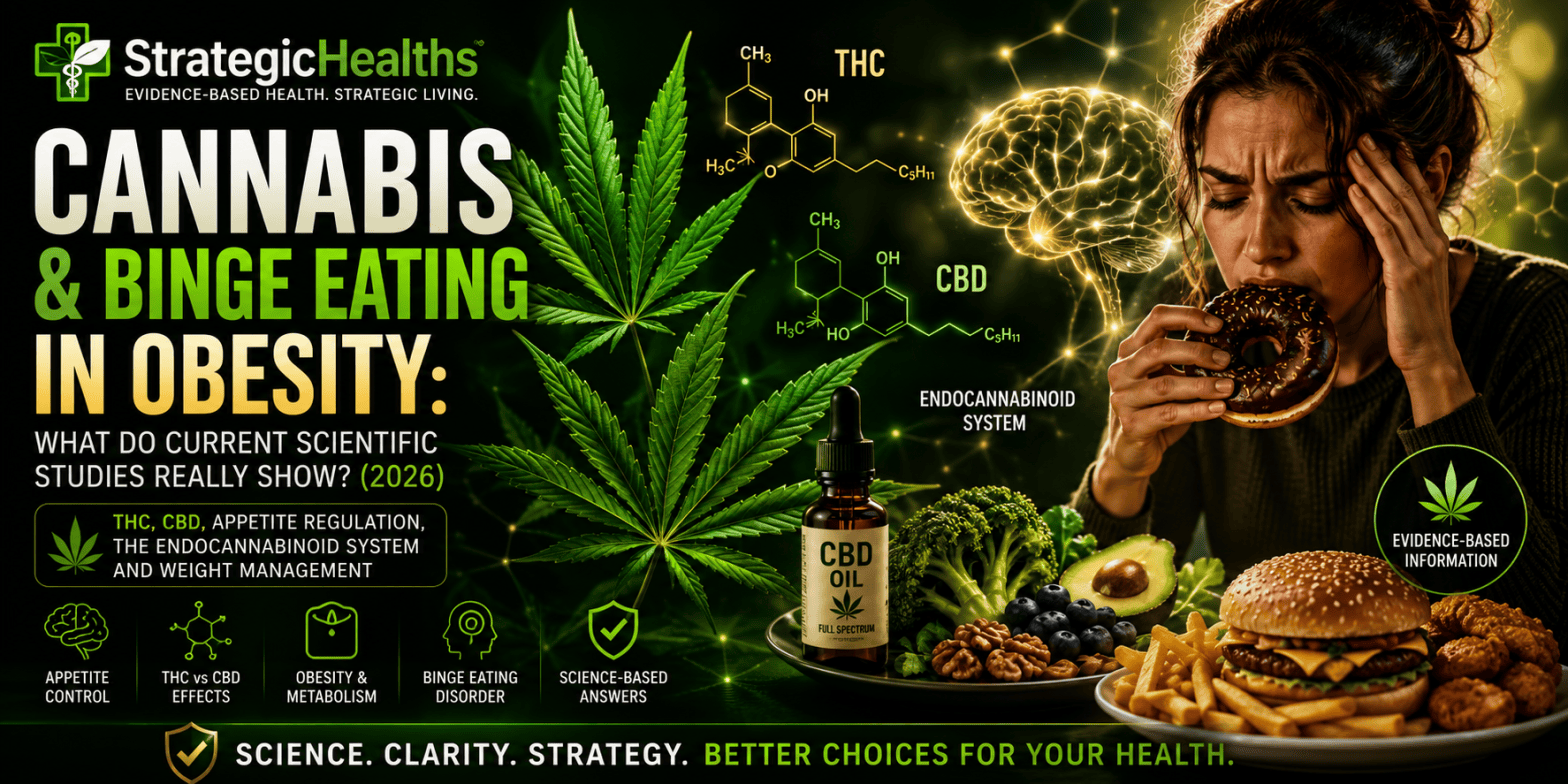

Evidence-Based Guide to THC, CBD, Appetite Regulation, Endocannabinoid System and Weight Management
🧠 Part 1 — Why Has Cannabis Become a Major Topic in Obesity Research?
For decades, cannabis was primarily associated with recreational use. Today, however, scientists are studying its potential role in chronic pain, epilepsy, anxiety disorders, multiple sclerosis, and metabolic diseases—including obesity.
One question has attracted particular attention:
Can cannabis influence appetite and binge eating in people living with obesity?
The answer is far more complex than many people realize.
Although cannabis is widely known for causing the famous “munchies”—an intense desire to eat after consuming THC—recent research suggests that different cannabinoids may have very different effects on hunger, satiety, metabolism, and body weight.
Understanding these differences is essential, especially as medical cannabis becomes more widely available worldwide.
🍔 What Is Binge Eating Disorder?
Binge Eating Disorder (BED) is currently recognized as the most common eating disorder worldwide.
It is characterized by recurrent episodes in which a person consumes unusually large amounts of food within a short period while experiencing a strong feeling of loss of control.
Typical episodes often include:
✅ Eating much faster than normal
✅ Continuing to eat despite feeling physically full
✅ Eating secretly because of embarrassment
✅ Feeling guilt, shame or emotional distress afterward
Unlike bulimia nervosa, binge eating episodes are not regularly followed by compensatory behaviors such as self-induced vomiting or excessive exercise.
For many individuals with obesity, binge eating represents one of the greatest barriers to successful long-term weight management.
⚖️ Obesity Is More Than Excess Body Fat
Modern science recognizes obesity as a complex chronic disease, not simply the result of eating too much.
Body weight is regulated by an intricate network involving:
🧠 The brain
🧬 Hormones
🍽️ Appetite-regulating pathways
❤️ Energy expenditure
🧪 Genetics
😴 Sleep quality
😟 Psychological stress
🌿 The endocannabinoid system
This explains why two people following the same diet can experience completely different weight-loss outcomes.
Among these biological systems, the endocannabinoid system has become one of the most intensively studied because of its powerful influence on hunger and food reward.
🌿 The Endocannabinoid System: The Body’s Hidden Appetite Controller
Most people associate cannabinoids only with cannabis.
In reality, the human body naturally produces its own cannabinoid-like molecules called endocannabinoids.
These molecules help regulate numerous physiological processes, including:
🍽️ Appetite
😊 Mood
😴 Sleep
🧠 Memory
🔥 Inflammation
⚡ Energy balance
💪 Metabolism
The two best-known endocannabinoids are:
• Anandamide (AEA)
• 2-Arachidonoylglycerol (2-AG)
They interact primarily with two receptor types:
🟢 CB1 Receptors
Mainly located in:
🧠 Brain
🍔 Hypothalamus
🧈 Adipose tissue
🍽️ Gastrointestinal tract
Activation of CB1 receptors generally:
✅ Increases hunger
✅ Enhances food pleasure
✅ Promotes fat storage
✅ Reduces satiety signals
🔵 CB2 Receptors
Found predominantly in:
🩸 Immune cells
🦴 Bone
🧬 Peripheral tissues
CB2 receptors appear to play a larger role in inflammation and immune regulation than in appetite itself.
🔬 Why Scientists Are So Interested
Researchers have discovered that many individuals living with obesity appear to have increased activity of the endocannabinoid system.
This overactivation may contribute to:
🍔 Increased appetite
🍕 Greater cravings for highly palatable foods
🍩 Preference for foods rich in sugar and fat
⚖️ Weight gain
🧈 Increased visceral fat
📈 Insulin resistance
Because of these findings, scientists have been investigating whether manipulating cannabinoid receptors could become a future strategy for treating obesity and binge eating.
However, current evidence indicates that the answer is far more nuanced than simply “using cannabis.”
📖 What You’ll Learn Next
In the next section, we’ll examine the most important distinction in cannabis science:
Why THC and CBD produce dramatically different effects on appetite, binge eating, metabolism, and body weight—and why confusing these compounds can lead to major misconceptions.
🔍 Key Takeaways
✔️ Obesity is a complex biological disease influenced by multiple physiological systems.
✔️ The endocannabinoid system plays a central role in regulating appetite and food reward.
✔️ CB1 receptor activation generally stimulates hunger and increases food intake.
✔️ Cannabis contains multiple cannabinoids with distinct biological effects.
✔️ Understanding the difference between THC and CBD is essential before interpreting scientific studies on obesity and binge eating.
🌿 Part 2 — THC vs CBD: Why Their Effects on Appetite Are Completely Different

Understanding the difference between THC and CBD is one of the most important aspects of cannabis science.
Many people mistakenly refer to cannabis as a single substance.
In reality, the cannabis plant contains more than 100 naturally occurring cannabinoids, each interacting differently with the human body.
Among them, tetrahydrocannabinol (THC) and cannabidiol (CBD) are by far the two most extensively studied compounds.
Although they originate from the same plant, they can produce remarkably different effects on:
🍽️ Appetite
⚖️ Body weight
🧠 Brain function
😌 Anxiety
😴 Sleep
🔥 Inflammation
🩺 Metabolic health
Understanding these differences is essential before interpreting any scientific study involving cannabis and obesity.
🧪 What Is THC?
THC (Δ9-tetrahydrocannabinol) is the primary psychoactive cannabinoid found in cannabis.
It is responsible for the well-known “high” associated with recreational cannabis use.
After consumption, THC readily crosses the blood-brain barrier and binds strongly to CB1 receptors, which are highly concentrated in brain regions responsible for:
🧠 Reward
😊 Pleasure
🍕 Hunger
🥐 Food motivation
💭 Memory
This activation explains why THC often increases both the desire to eat and the pleasure derived from food.
🍔 Why Does THC Increase Appetite?
The phenomenon commonly known as the “munchies” has been extensively investigated.
Current evidence suggests that THC influences appetite through multiple biological pathways simultaneously.
🧠 1. Activation of Brain Reward Centers
THC stimulates dopamine release within the brain’s reward circuitry.
As a result:
✅ Food becomes more pleasurable.
✅ Cravings become more intense.
✅ Highly processed foods become especially attractive.
Many users report craving foods rich in:
🍩 Sugar
🍕 Fat
🍟 Salt
rather than healthier options.
👃 2. Enhanced Smell and Taste
THC also increases sensory perception.
Food aromas become more intense.
Flavors appear richer.
Meals become more rewarding.
Even ordinary foods may seem unusually appealing.
🧬 3. Stimulation of Appetite Hormones
Experimental studies suggest THC may influence hormones involved in energy regulation, including:
🍽️ Ghrelin
🩸 Leptin signaling
🧠 Hypothalamic appetite pathways
These hormonal changes can further enhance food-seeking behavior.
📈 THC and Binge Eating: Is There a Connection?
This question has become increasingly important.
Current scientific evidence indicates that:
✅ THC clearly increases appetite in many individuals.
However,
❌ Current evidence does not demonstrate that THC alone causes Binge Eating Disorder (BED).
Instead, researchers believe THC may increase the likelihood of binge eating episodes in individuals who already have underlying vulnerabilities, such as:
⚠️ Emotional eating
⚠️ Existing binge eating disorder
⚠️ Obesity
⚠️ Depression
⚠️ Anxiety
⚠️ Chronic stress
In these individuals, heightened food reward may contribute to episodes of loss of control.
🌿 What About CBD?
CBD (Cannabidiol) behaves very differently.
Unlike THC, CBD has little direct activation of CB1 receptors and does not produce intoxication.
Instead, CBD interacts with multiple biological systems, including:
🧠 Serotonin receptors
🔥 Inflammatory pathways
🩸 Oxidative stress mechanisms
⚡ Cellular signaling pathways
Because of these diverse mechanisms, CBD has attracted considerable attention as a potential therapeutic compound.
🍽️ Does CBD Increase Appetite?
Unlike THC, the answer is usually:
Probably not.
Several clinical studies suggest that CBD may have:
✅ Neutral effects on appetite.
✅ Mild appetite-reducing effects in some individuals.
✅ No significant effect in others.
At present, evidence remains inconsistent, and researchers agree that CBD should not be promoted as a weight-loss treatment.
Further high-quality clinical trials are needed.
⚖️ THC vs CBD: A Scientific Comparison

🔬 Why Current Research Is So Challenging
One reason the scientific literature sometimes appears contradictory is that studies differ substantially.
Researchers investigate different:
🌿 Cannabis strains
💊 THC concentrations
🌱 CBD concentrations
⚖️ THC:CBD ratios
💨 Routes of administration
👥 Patient populations
⏳ Treatment durations
Consequently, results cannot always be directly compared.
This explains why some studies report increased calorie intake, while others observe little or no effect on body weight.
📖 Coming Up Next
In the next section, we’ll explore one of the most surprising findings in obesity research:
Why do some long-term cannabis users appear to have lower body weight than expected, despite THC’s appetite-stimulating effects?
We’ll examine current evidence on body composition, metabolism, insulin sensitivity, visceral fat, and the complex relationship between cannabis use and obesity.
🔍 Key Takeaways
✔️ THC and CBD have fundamentally different biological effects.
✔️ THC strongly activates CB1 receptors and generally increases appetite and food reward.
✔️ CBD is not intoxicating and does not consistently increase hunger.
✔️ Current evidence does not support the conclusion that THC alone causes Binge Eating Disorder.
✔️ Individual susceptibility, psychological factors, and metabolic health likely influence how cannabis affects eating behavior.
🌿 Part 3 — Can Cannabis Become a Future Treatment for Obesity and Binge Eating?

🧬 Current Clinical Evidence: What Have Human Studies Found?
Aborde:
- Clinical trials involving THC
- Clinical trials involving CBD
- Combination therapies
- Weight loss outcomes
- Appetite changes
- Binge eating frequency
- Metabolic markers
- Current limitations of the evidence
⚖️ Cannabis and Weight Loss: Myth or Reality?
Responder perguntas como:
✅ Does cannabis cause weight loss?
✅ Why are some cannabis users leaner despite eating more?
✅ Is appetite the only factor determining body weight?
Explicar:
- Energy expenditure
- Brown adipose tissue (evidência limitada)
- Insulin sensitivity
- Gut microbiota (pesquisas iniciais)
- Physical activity
- Lifestyle confounders
💊 Could CBD Become a Future Therapy for Binge Eating?
Explicar:
🧠 Anxiety reduction
😴 Sleep improvement
🔥 Inflammation
🍽️ Appetite regulation
⚖️ Emotional eating
Destacar claramente:
Current evidence remains insufficient to recommend CBD as a treatment for obesity or binge eating disorder outside established medical indications.
⚠️ Potential Risks and Side Effects
Dividir em blocos.
🚫 THC
- Increased appetite
- Anxiety
- Memory impairment
- Tachycardia
- Impaired driving
- Dependence risk
🌿 CBD
- Drug interactions
- Liver enzyme elevation
- Gastrointestinal symptoms
- Drowsiness
- Pregnancy precautions
👨⚕️ Who Should Avoid Cannabis?
Criar lista objetiva.
❌ Pregnancy
❌ Breastfeeding
❌ Adolescents
❌ History of psychosis
❌ Severe psychiatric illness
❌ Uncontrolled cardiovascular disease
❌ Individuals with substance use disorder
📊 Scientific Evidence Ranking

📊 Summary of Current Scientific Evidence

🔎 Key Message
Current evidence indicates that THC, CBD, and THCV have distinct biological effects and should not be considered interchangeable. THC consistently stimulates appetite, CBD appears metabolically neutral with potential indirect benefits, while THCV has emerged as the most promising cannabinoid for future obesity research. However, none of these compounds currently has sufficient high-quality evidence to be recommended as a first-line treatment for obesity or binge eating disorder. Evidence-based interventions—including nutritional therapy, physical activity, behavioral treatment, and approved anti-obesity medications when indicated—remain the cornerstone of obesity management.
Evidence Strength: ⭐⭐⭐☆☆ (Moderate overall). While mechanistic and preclinical evidence is strong, additional large-scale randomized controlled trials are required before cannabinoids can be routinely incorporated into obesity treatment guidelines.
💡 Practical Recommendations
✔ Maintain a balanced diet.
✔ Prioritize regular physical activity.
✔ Treat binge eating with evidence-based approaches.
✔ Seek medical evaluation before using cannabinoid products.
✔ Do not replace conventional obesity treatment with cannabis products without professional guidance.
🔗 Suggested Internal Links
Preservando o padrão do StrategicHealths com o emoji original no título:
- ⚖️ Obesity: Causes, Risk Factors, Prevention and Evidence-Based Treatment
- 💊🧬 Anti-Obesity Medications: What Science Really Says
- 💊 Type 2 Diabetes Medications and Supplements: What Science Really Says
- 🫀 Fatty Liver (MASLD): Can Exercise and Supplements Reverse Liver Fat? What Science Really Says
- 🔥 Chronic Stress: What Science Really Says
- 🌿 Ashwagandha: Benefits, Dosage, Safety, and What Science Really Says (2026)
- 🌿 Probiotics Explained: A Pharmacist’s Evidence-Based Guide
- ❤️ Omega-3 Benefits: What Science Really Says About Heart, Brain, and Longevity
🛒 Recommended Products
Disclosure: As an Amazon Associate, StrategicHealths may earn from qualifying purchases at no additional cost to you.
🧠 Books
📖 The Endocannabinoid System: Genetics, Biochemistry, Brain Disorders, and Therapy
📖 Cannabis and Cannabinoid Research
⚖️ Weight Management
✔ Smart Digital Body Weight Scale
🍱 Nutrition
✔ Portion Control Meal Prep Containers
🥗 Healthy Eating
✔ Mediterranean Diet Cookbook
📒 Lifestyle
✔ Food & Mood Journal
⌚ Activity Tracking
✔ Fitness Tracker Smartwatch
😴 Sleep
✔ Sleep Mask for Better Sleep Quality
🧩 Brain Health
✔ Puzzle & Cognitive Training Book (supportive lifestyle tool)
⚠️ Clinical Advisory
Although research on cannabinoids has expanded considerably over the past decade, current scientific evidence does not support cannabis, THC, CBD, or other cannabinoids as first-line treatments for obesity or binge eating disorder.
Obesity is a complex, chronic disease that requires individualized, evidence-based management. Depending on each patient’s clinical condition, treatment may include nutritional counseling, regular physical activity, behavioral therapy, psychological support, FDA-approved anti-obesity medications, and, in selected cases, bariatric surgery.
Likewise, binge eating disorder is a recognized psychiatric condition that should be diagnosed and managed by qualified healthcare professionals. Delaying appropriate treatment in favor of unproven therapies may worsen both physical and mental health outcomes.
Cannabis-derived compounds remain an active area of research, but larger, long-term randomized clinical trials are still needed before these substances can be routinely recommended for weight management or eating disorders.
Evidence-Based Recommendation: Individuals seeking treatment for obesity or binge eating should consult a qualified healthcare professional and follow interventions supported by current clinical guidelines rather than relying on cannabinoids as a primary therapeutic strategy.
✅ Conclusion
Current scientific evidence demonstrates that the relationship between cannabis, appetite, obesity, and binge eating is considerably more complex than commonly portrayed.
THC consistently increases appetite and enhances food reward, while CBD appears to exert distinct biological effects and does not reliably stimulate hunger. Despite promising research on the endocannabinoid system, there is currently insufficient evidence to recommend cannabis or CBD as primary treatments for obesity or binge eating disorder.
Future high-quality clinical trials will be essential to clarify whether specific cannabinoids may eventually play a therapeutic role in metabolic health. Until then, effective management of obesity continues to rely on evidence-based strategies, including nutrition, physical activity, behavioral therapy, approved pharmacological treatments when indicated, and individualized medical care.
📚 References
- Di Marzo V, Matias I. Endocannabinoid control of food intake and energy balance. Nature Neuroscience. 2005;8(5):585–589.
- Kirkham TC. Endocannabinoids and the neurochemistry of gluttony. Journal of Neuroendocrinology. 2008;20(Suppl 1):109–114.
- Silvestri C, Di Marzo V. The endocannabinoid system in energy homeostasis and the etiopathology of metabolic disorders. Cell Metabolism. 2013;17(4):475–490.
- Engeli S. Dysregulation of the endocannabinoid system in obesity. Journal of Neuroendocrinology. 2008;20(Suppl 1):110–115.
- National Institute on Drug Abuse (NIDA). Cannabis (Marijuana) Research Report.
- Pertwee RG. The diverse CB1 and CB2 receptor pharmacology of THC and CBD. British Journal of Pharmacology. 2008;153:199–215.
- Iffland K, Grotenhermen F. An update on safety and side effects of cannabidiol. Cannabis and Cannabinoid Research. 2017;2(1):139–154.
- Boggs DL, et al. Clinical and preclinical evidence for functional interactions of cannabidiol and Δ9-THC. Neuropsychopharmacology. 2018.
- National Academies of Sciences, Engineering, and Medicine. The Health Effects of Cannabis and Cannabinoids. Washington, DC: National Academies Press; 2017.
- Volkow ND, Baler RD, Compton WM, Weiss SRB. Adverse health effects of marijuana use. New England Journal of Medicine. 2014;370:2219–2227.
- European Association for the Study of Obesity (EASO). Clinical guidance on obesity management.
- American Diabetes Association. Standards of Care in Diabetes – 2026.
- Whiting PF, et al. Cannabinoids for medical use: A systematic review and meta-analysis. JAMA. 2015;313(24):2456–2473.
- Chesney E, et al. Adverse effects of cannabidiol: A systematic review and meta-analysis. Neuropsychopharmacology. 2020.
- National Institutes of Health (NIH). Office of Dietary Supplements and National Center for Complementary and Integrative Health (NCCIH). Evidence on cannabis and cannabinoids.
- World Health Organization (WHO). Obesity and overweight. Updated guidance.
- World Obesity Federation. Global obesity data and policy recommendations.
- Bray GA, Frühbeck G, Ryan DH, Wilding JPH. Management of obesity. The Lancet. 2016;387:1947–1956.
- Apovian CM, Aronne LJ, Bessesen DH, et al. Pharmacological management of obesity: Endocrine Society Clinical Practice Guideline. Journal of Clinical Endocrinology & Metabolism.
- Rubino F, et al. Joint international consensus statement for metabolic surgery in obesity. Diabetes Care.
Leave a Reply